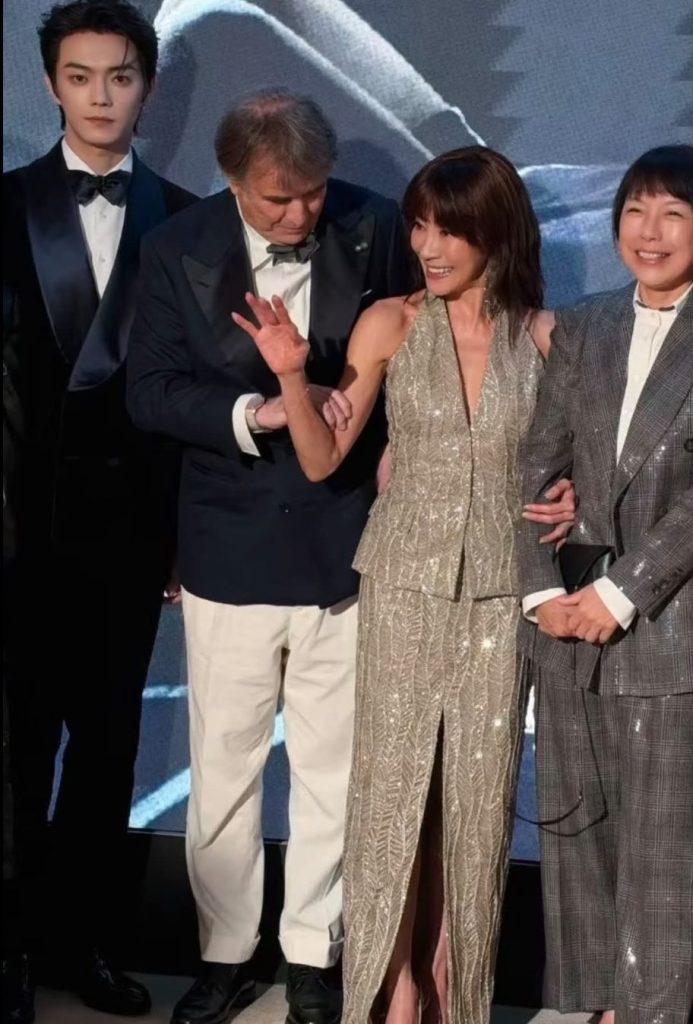





























29th October 2026 – (Shanghai) Play the video a couple of times and the sequence becomes clearer. It begins with a European‑style cheek kiss. His hand then moves from Liu Tao’s shoulder down to her waist. Many viewers feel it lingers too long somewhere between her waist and her chest. She shifts sideways and pulls her shoulders in. For the group photo, he draws her close, and she keeps a polite work smile until the shot is taken. When she turns away, the smile fades.
The footage comes from a Brunello Cucinelli event in Shanghai on 22nd October, and it has spread across Chinese social media this week. Users have since dug up older pictures that they say show the 73-year-old founder holding other women the same way. They name Chen Duling at the same evening, plus Kim Yoo-jung, Eileen Gu and Li Xiaoran at earlier appearances. Some commenters call it blatant harassment. Others say it is Western social warmth, or that a short edited clip cannot show the whole exchange. So far Liu, Chen and the company have said nothing in public.
That silence matters, and fairness matters too. No complaint has been filed, and none of the women in these pictures has accused him of anything. What exists is a set of images and the public’s reading of them, and both facts deserve weight. Still, images can be studied. The question of why a powerful man might behave like this in front of cameras deserves a slow answer rather than a fast verdict.
Start with the setting. A brand photocall is a workplace with lights. The actress is there to appear, to smile and to make the label look good. The founder is the reason the room exists at all. Karen Morash wrote in The Conversation in 2017, after the Kevin Spacey allegations at the Old Vic. She argued that harassment in performance industries grows out of hierarchy and from treating some people “as commodities rather than equals”. She also noted that a surplus of talent leaves performers afraid that speaking up will cost them work. A celebrity looks powerful from outside, but next to the man who signs the ambassador contracts she has little room. Liu’s body language reads like someone who understood that maths exactly. She made space where she could and smiled where she had to.
Then look at how Cucinelli sees himself. There is plenty of evidence here, and much of it comes from the man himself. This year he released Brunello: The Gracious Visionary, a two-hour film about his life. He commissioned it, and Giuseppe Tornatore of Cinema Paradiso directed it. His daughter Camilla told ELLE that her father wanted a film because a book alone would not reach younger people. The Guardian’s Cath Clarke called it a vanity project “with a capital ‘V'”. She pointed out that it even includes archive footage of the young Cucinelli playing Jesus Christ in an Easter Passion play. The film then toured, with an Asian gala screening at Tai Kwun in Hong Kong.
A man who pays an Oscar winner to film his own goodness is telling us how he wants to be seen. He picked “gracious” and he picked “visionary”. Psychologists who study the “dark triad” of narcissism, psychopathy and Machiavellianism describe a narcissist who assumes his attention is a gift the other person should welcome. Nobody can diagnose a stranger from a documentary and a phone clip, and nobody should try. However, a self-made myth has practical effects. Suppose a man has been told for decades, and has told himself on a cinema screen, that he is kind and humane. A woman’s discomfort beside him may simply not register. Her stiffening looks like shyness to him. Her turning away looks like modesty. In his own story, his touch is warmth.
A 2016 paper in Personality and Individual Differences adds a harder thought. The traits that help some people rise may overlap with the traits that let them exploit others. Those traits include confidence, appetite and indifference to other people’s hesitation. Some industries offer niches where that mix pays off. Luxury fashion, which runs on access, image and patronage, is one of them. A University of Padova study by Silvia Galdi, Anne Maass and Mara Cadinu found something similar. Men shown objectifying television became more willing to harass and more attached to traditional ideas of male dominance. Italian television of that kind shaped a generation of men Cucinelli’s age. That excuses nothing, though it does help explain where certain habits come from.
Crowds rarely object in the moment. Cameras click, guests clap, and a man who keeps touching meets no resistance except the quiet retreat of the woman herself. A silent room can be mistaken for permission. Each event that passes without consequence makes the next one feel normal. Brands that hire actresses as their faces should write conduct terms into those contracts, with clear boundaries agreed before anyone steps onto the carpet. Morash recommended exactly that for rehearsal rooms. And the industry should make it cheaper and safer for the women at these photocalls to speak up.