
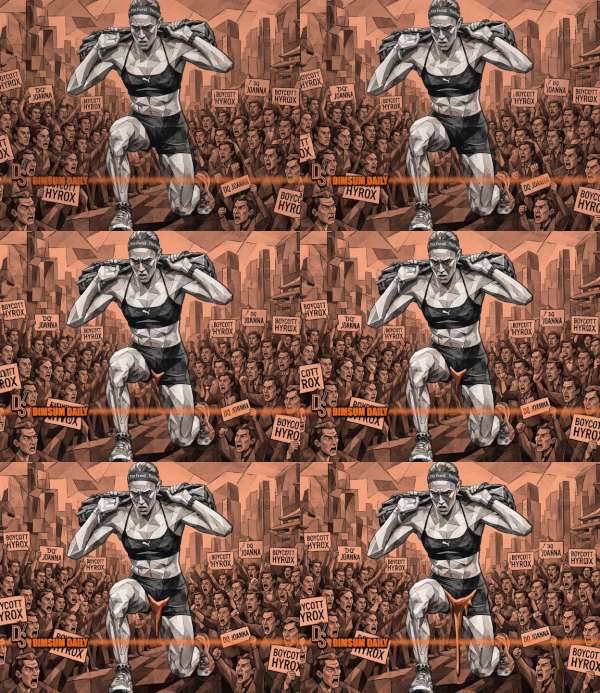



























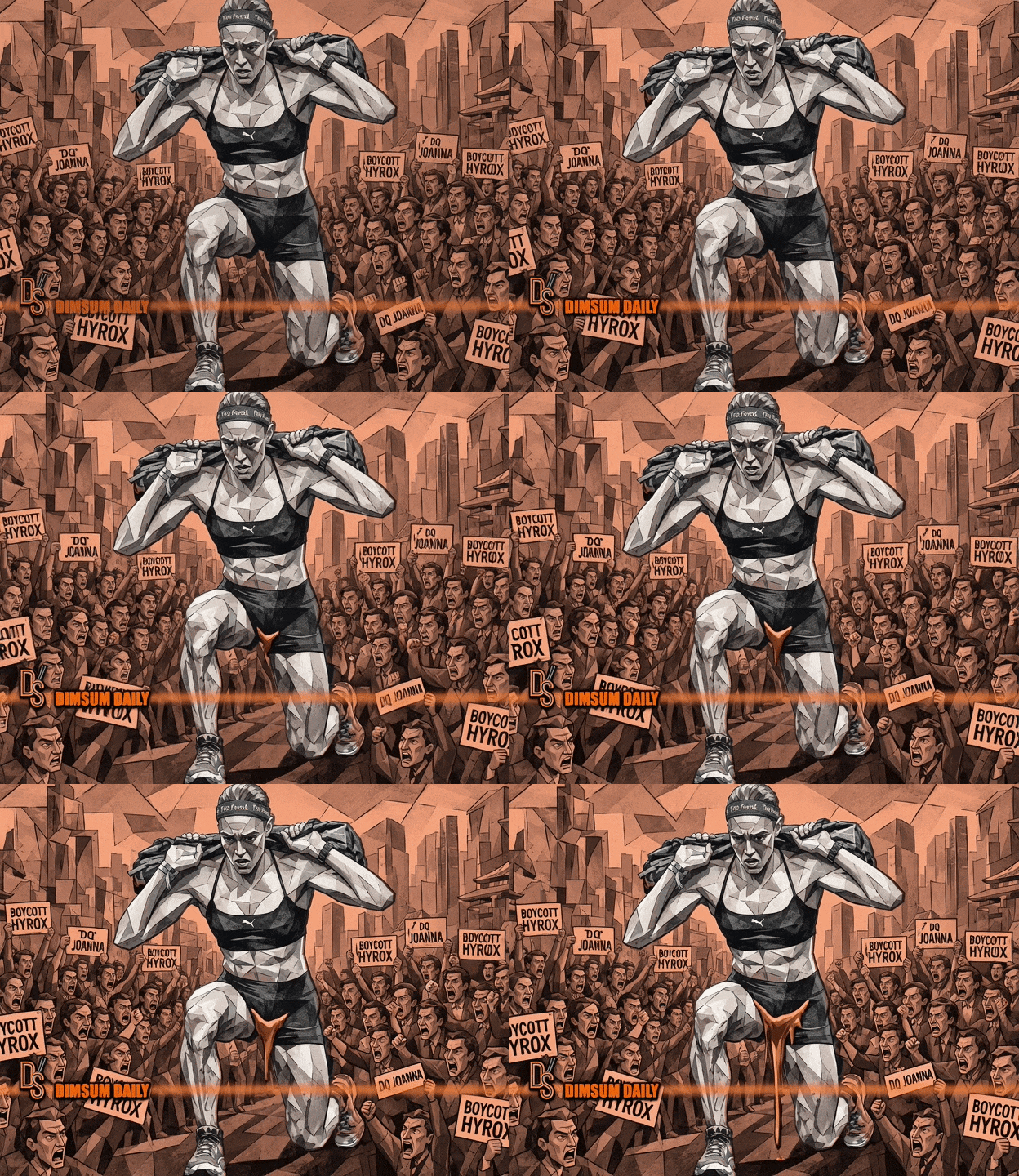
16th September 2026 – (Beijing) Three days is the industry number. Anyone who has sat in a crisis-communications room knows the arithmetic: outrage peaks on day one, the commentators arrive on day two, and by day three the algorithm has moved the crowd along to the next spectacle. HYROX is now betting on that arithmetic. Its co-founder Moritz Fürste has issued a personal apology, the organisation has promised rulebook changes, and the venue in Beijing has been scrubbed, re-carpeted and reopened. The machinery is working exactly as designed. Post once, go quiet, wait for the wind to change. The wind, however, is not going to change here, because what happened at the National Speed Skating Oval on 12th September was not a communications problem. It was a hygiene problem, and no press release disinfects that.
Joanna Wietrzyk suffered faecal incontinence mid-race, continued through shared rowing machines, sandbags, sleds and running lanes with waste running down her legs, crossed the line first in 1:01:23, and then told the world “go hard or go home… a win is a win” before deleting the post. Other competitors reportedly became unwell. Volunteers, many unpaid, cleaned up human waste without protective equipment. And the result still stands. That last fact is the one everything else orbits around. An apology that leaves the contaminated victory intact is confirmation that the harm was acceptable so long as the marquee name kept her trophy.
Meanwhile, on 13th August, a Malaysian competitor named Zarif Zakaria ran the Men’s Open, crossed the line in 1:27:48, and was then stripped of his result — disqualified for starting late because he had taken a toilet break moments before his heat. A man is erased from the standings for going to the bathroom before his race; a woman is crowned champion for losing control of her bowels during hers. One followed the etiquette HYROX claims to prize and was punished for a scheduling technicality. The other left biological waste across shared equipment and kept her trophy. This is not a hypothetical about how the rulebook might be applied unevenly.
Hyrox’s defence has fallen apart. This is an organisation that penalises spitting, clearing one’s nose on the floor, and reportedly even sanctioned a competitor for splashing water on her own face. Its own rulebook frames basic hygiene as a public‑health issue. Yet an athlete who left biological contamination across shared equipment was allowed to continue and take first place. A body that punishes a droplet of water while effectively endorsing faecal contamination has not enforced its standards. It has exposed those standards as cosmetic—applied to the anonymous field and set aside for the Elite 15.
Then there is the ordering of HYROX’s priorities, which is more revealing than the incident itself. The first substantive public statement did not apologise to the competitors whose lanes were fouled. It praised elite athletes for pushing past their limits, reframed the episode as “ambiguity” between elite and mass-participation protocols, and threatened permanent global bans against anyone deemed to be attacking the athlete online. The world-record holder’s victory was protected. The people who raced beside her, breathed the air, touched the equipment and paid hundreds of dollars for the privilege were not even named. And critics asking reasonable questions about accountability were recast as a mob to be policed.
Joe Ho, a paying competitor in Beijing, asked a contractual question: “I paid HYROX to provide a professionally organised and safe event.” He asked why affected participants were not being offered refunds, credits, or meaningful compensation. He is right. The paying field is the customer here, and the customer was exposed to a genuine physical and psychological hazard through no fault of their own. Supporting Ho is not piling on an athlete; it is insisting that the people who actually fund this enterprise are treated as more than background scenery.
And they do fund it. Follow the money, because the money explains the silence. HYROX changed hands on 8th September, four days before Beijing, when a consortium led by L Catterton — the LVMH-backed consumer-investment firm — took majority control in a deal reportedly valuing the brand near €600 million and possibly higher. The founders did not cash out; they borrowed to increase their stake. The revenue engine runs on entry fees of roughly ninety to a hundred and forty dollars a head, spectator tickets, merchandise and vendor cuts, across more than a hundred events and 1.4 million participants heading towards two million. Elite athletes race free because they are the marketing. Now weigh that structure against the crisis. An organisation carrying personal debt against relentless growth cannot afford to annul a viral champion’s result, because the champion is the content, and the content sells the entry fees that service the debt. The institutional logic points in exactly one direction i.e. protect the asset, manage the optics, wait three days. Expect fees to drift upward, as they did under private equity at Ironman, and expect the same commercial calculus to keep producing decisions like this one.
So the analysis leads somewhere unambiguous. Wietrzyk should be disqualified, the result annulled, and given her unrepentant “a win is a win,” banned. The competitors exposed should be compensated. And until HYROX does this rather than merely apologising for it, athletes and regulators around the world are entitled to withhold their registrations and their venues. HYROX is counting on your forgetting. Declining to forget is the whole point.