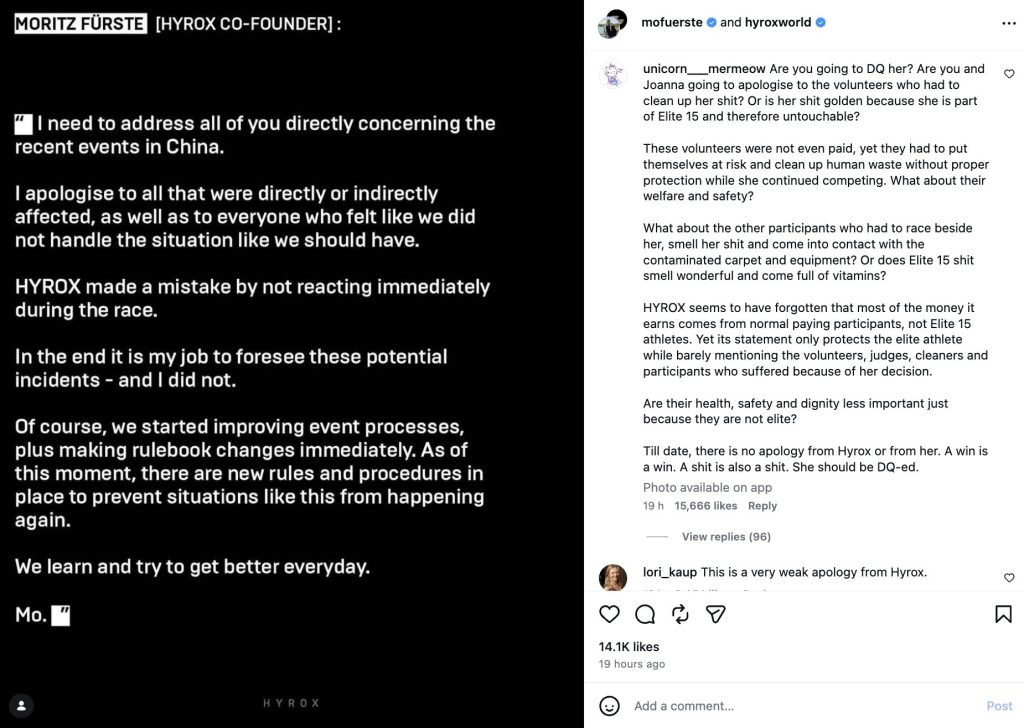





























15th September 2026 – (Beijing) Three days on from the events of 12th September at HYROX Beijing, the picture is no longer obscured by the shock of the moment or the reflexive defences of those involved. The athlete at the centre of it, Joanna Wietrzyk, soiled herself mid-race, continued through the shared stations regardless, and went on to win — then defended herself with “go hard or go home… a win is a win,” thanking supporters and promising to return before quietly deleting the post. There was no apology to the competitors whose lanes and equipment she had fouled, and organisers have done little to dampen the resulting furore. What remains, once examined slowly and without haste, is a straightforward conclusion the organiser has spent the week trying to avoid – an apology, however personal in tone, cannot substitute for the one action that would actually restore trust. HYROX did not disqualify Wietrzyk. It kept her victory intact. And until that reversal is made, both China and Hong Kong have every reason to close their doors to the franchise entirely.
Her coach, Chris Bayens, has described the incident as “extraordinary” and “unforeseen.” Co-founder Moritz Fuerste, in his Monday-night apology, conceded that foreseeing such situations “was his job” and that he had failed to do it. These two framings sit uneasily together. Something cannot be genuinely unforeseeable and simultaneously a foreseeable duty that was neglected. The truth is that acute incontinence during extreme endurance exertion is a documented physiological risk, well known within endurance sport. It was not a bolt from a clear sky. It was a hazard the organiser chose not to plan for, and “extraordinary” is simply the word one reaches for when accountability becomes inconvenient.
The hygiene argument is where the case against HYROX becomes unanswerable. This is not an open-road marathon where contamination disperses into the environment. It is an indoor format built on shared surfaces used in immediate succession i.e. rubber mats, sled handles, rowing machines, sandbags and running lanes touched by competitor after competitor. When bodily waste is left across that equipment, the risk is not private but communal, transmitted station by station down the field. Officials at the venue reportedly noticed the contamination, escalated it, and responded by shifting mats so others could skirt the affected zone rather than halting the race. That is not crisis management. It is a decision to preserve the spectacle while quietly rerouting participants around a biological hazard. No promise of overnight deep-cleaning answers for the exposure that was permitted to occur in real time.
The inconsistency in the rulebook only sharpens the point. HYROX imposes a two-minute penalty for spitting, for so-called snot rockets, for littering. One competitor reportedly drew a penalty simply for splashing water on her own face. Yet an athlete whose contamination allegedly caused a following competitor to slip finished with no sanction and the top prize secured. A governing body that punishes a droplet of water while waving through faecal contamination of shared equipment has not enforced its rules. It has revealed that those rules were written for appearances.
Then there is the question of even-handedness, which HYROX headquarters has handled worse than the incident itself. The English-language statement from HYROX World praised athletes for “pushing themselves to the highest levels,” reframed the episode as a matter of ambiguity between elite and mass-participation rules, and threatened permanent global bans against those it deemed to be launching personal attacks. There was no apology in it to the competitors whose lanes and equipment were fouled. This ordering of priorities is telling. A world-record holder’s victory was protected; the athletes who ran through the aftermath were not even acknowledged. It is reasonable to ask whether a less celebrated, non-Western competitor would have been extended the same latitude. The suspicion that the answer is no is not a fringe grievance. It is the natural reading of an organisation that shielded its marquee name at the direct expense of the anonymous field behind her.
Chinese state broadcaster CCTV framed the matter correctly i.e. genuine athletic struggle is not “toughing it out” in disregard of public hygiene and the rights of others, but self-challenge conducted within respect for rules and one’s own limits. That distinction matters. The valorisation of endurance-at-any-cost is precisely the culture that produced a contaminated racecourse and a champion who posted “a win is a win” from a hospital bed before deleting the message, offering neither explanation nor apology to those she affected.
An apology that is not accompanied by disqualification is, in practical terms, a statement that the result stands and the harm was acceptable. HYROX cannot claim to have learned its lesson while continuing to certify the very outcome that embodies the failure. The remedy is not another statement. It is the annulment of the Beijing result, the introduction of a clear, uniformly applied rule mandating removal of any athlete suffering uncontrolled biological contamination, and a direct apology to the competitors exposed.
Absent those steps, regulators and consumers in China and Hong Kong should decline to host or fund the franchise, and participants should withhold their registrations. A boycott is not an overreaction. It is the measured response of a public that has been told, in the plainest possible terms, that the show will always come before their safety.