



















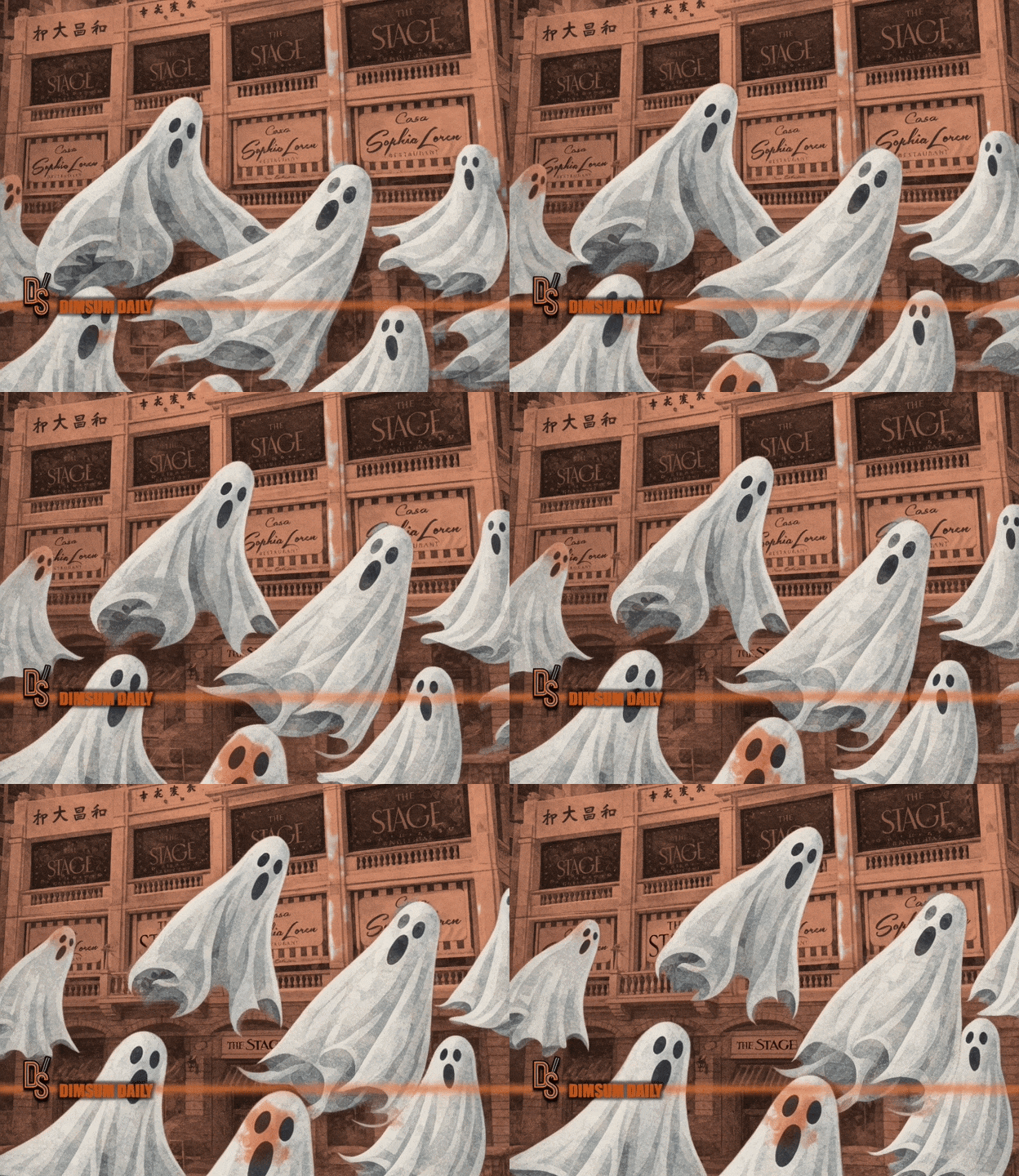
11th August 2026 – (Hong Kong) Walk past the Woo Cheong Pawn Shop tonight and the first thing you notice is not the verandahs or the green facade. It is the dark. All three restaurant floors are out, the listings switched to “Closed”, and the group’s Instagram has been cut to a single word. People in Wan Chai have started to talk about the place the way they talk about an unlucky seat at the mahjong table. A curse, they say. The dining curse of Johnston Road.
The building deserves a little awe. It is a row of four linked Guangzhou-style tong lau with verandah galleries, put up between 1888 and the early 1900s, and it survived the century’s worth of trams rattling underneath. In 2007 the Urban Renewal Authority spent more than fifteen million Hong Kong dollars bringing it back, then did the obvious thing: leased it out to upmarket bars and restaurants. That is when the litany began. The Pawn left in 2021. Woo Cheong Tea House lasted about two years and was gone by the end of 2023. Then an Italian brand co-founded by an Oscar-winning actress took over the block, pizzeria, fine dining, music lounge, first overseas outpost, city talking point. In February the first floor folded. By this month, everything had. So the curse gets another telling. But a curse is something you cannot explain. This you can add up.
The numbers are on the listing sheet, for anyone who cares to look. The street-level floor, 3,877 square feet, was asking three hundred and twenty thousand Hong Kong dollars a month. Management and air-conditioning charges ran to another twenty-one thousand. Government rates took five per cent of rent on top. Now do the quiet part of the sum: how many pizzas does a restaurant have to sell to carry that? And to whom? The online commenters, with the brutal clarity of people who have no money at stake, pointed at the downstairs bar. It lived on the expatriate crowd, the ones who ran a tab and did not look at it. When the big spenders left, the bar was already a countdown. The landlord, reportedly, might drop the rent into the two-hundred-thousand range. That is not a different business. That is the same business, dying more slowly.
Here is the uncomfortable shape of it. The building was saved because it was too historic to lose. Having saved it, the city could not bear to let it be ordinary, so it charged heritage-restoration rent. That rent demanded a premium concept. The premium concept demanded a premium crowd. And the premium crowd has emigrated, or spends its weekends in Shenzhen, or has quietly decided that a Neapolitan pizza in a beautiful old shell is not worth what it costs. The building’s grandeur is its own trap. Every new tenant arrives certain the address will do the work, the verandahs and tramway view covering the food. Every one learns, in about two years, that the address covers nothing.
It is not only Woo Cheong, of course. More than sixty outlets shut across the city in the first half of this year, and dining was the worst-hit district of the lot. The headline figure sounds reassuring: restaurant receipts at ninety-five per cent of 2018. But the average conceals the chasm. Non-Chinese restaurants are running seven per cent above their pre-pandemic level, fast food eleven per cent above, and Chinese restaurants a quarter below. Hong Kong is not eating less. It is eating cheaper, or across the border, or at home. Into that market, someone installed a four-storey Italian flagship priced for a city that no longer exists.
The public response has been funnier and more honest than the press releases. The most popular suggestion for the building’s next life is to restore its original trade and run it as a pawnshop again; in a weak economy, the reasoning goes, people need cash. A haunted-house escape room runs a close second. Both jokes are diagnoses. The pawnshop is the one business the place was actually built for, the one whose margins never depended on a vanished clientele. The escape room is what you do with a heritage shell when you have run out of ideas for feeding people in it.
The lesson the city keeps refusing to draw is a simple one. A restored landmark is not a commercial proposition. It is a public good dressed in a lease, and as long as the Woo Cheong Pawn Shop has to earn its own keep at heritage-restoration rents, it will keep eating tenants, and the tenants will keep taking the blame for a curse that is really a price.