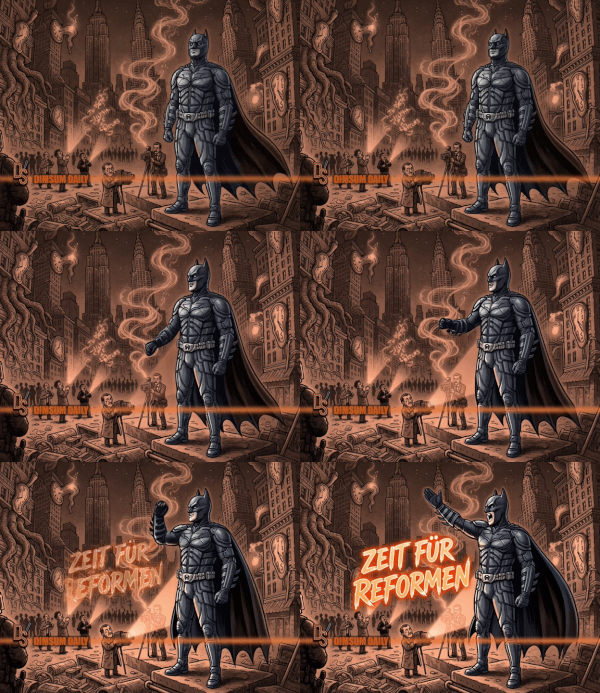



























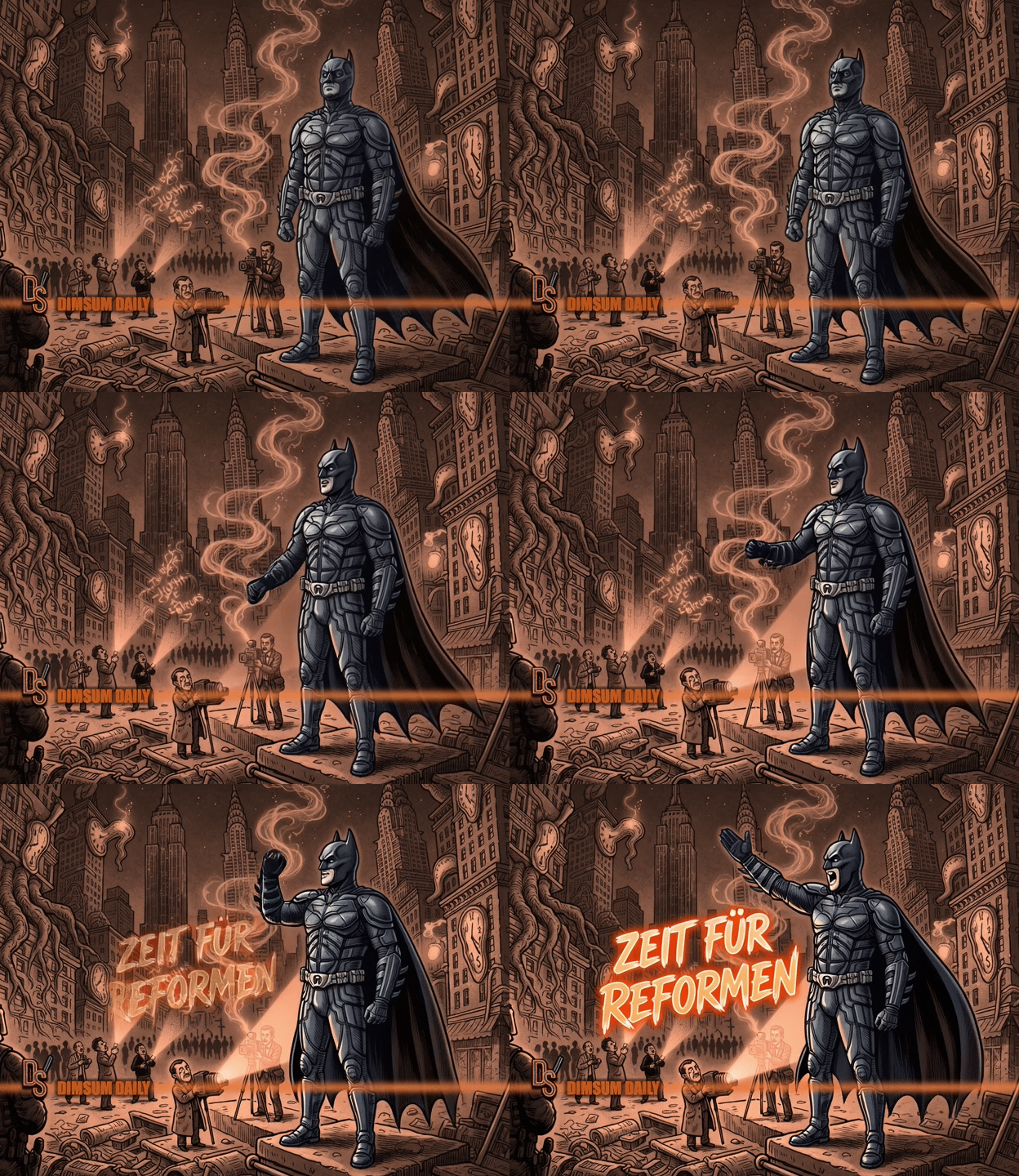
2nd November 2026 – (Berlin) One photograph from Frankfurt on Saturday night stays with you longer than the fires. Police officers are leading away a young man dressed as Batman. The organisers of Gen Z regelt held their day of action on Halloween to draw a bigger crowd, so costumes were expected. By late evening, police had closed off the main shopping street. The windows of a gun shop were smashed and Molotov cocktails had been thrown at emergency crews. A boy in a cape ended up as the image of a nation’s unease, which is a heavy load for a cape to carry.
The official response came quickly. Interior Minister Alexander Dobrindt told Bild that “violent left-wing groups and troublemakers from migrant communities” had hijacked the protests, without giving details. Hesse’s interior minister, Roman Poseck, said “around 100 clearly identified left-wing extremists” were in Frankfurt. Both claims may be true. Loosely organised movements cannot check who joins the back of a march, and police in Cologne, Berlin and Hamburg all said the evening crowds looked very different from the daytime ones. But the infiltrator story is convenient for the people telling it. It shifts the debate from what the marchers wanted to who broke the glass. A minister can promise “harsh punishments” much more easily than he can promise a dry ceiling.
Janelle Schulz, a Berlin high school student, told AP that water damage is bringing down the ceiling at her school, the toilets are broken and the school is short of teachers. Her account explains the German movement’s most distinctive demand. The marchers in Paris, Lisbon and Madrid are protesting about schools and rents. Young Germans are also protesting against a possible return of compulsory military service. A placard in Dresden summed it up: “The rich want war, the youth want a future!”
A state that cannot fix a school roof is thinking about asking the same students for a year of their lives in uniform. Conscription is the oldest version of the social contract. Citizens give service, and the state gives them protection, dignity and a real share in the country they are defending. When the state’s side of the deal looks worn out, the call to serve starts to feel like a bill handed to people who never got to order.
The numbers show why so many young people think the account is already in arrears. A French government report in October found that pension spending rose by 2.5 percentage points of GDP between 2000 and 2023, while education spending fell by 0.5. Nearly a third of the French education ministry’s budget now goes on pensions. According to the OFCE think tank, people over 60 make up a quarter of France’s population and hold 60 per cent of its wealth. Across the EU, 18- to 24-year-olds have the highest risk of poverty or social exclusion, at 26.3 per cent, compared with 18.8 per cent for people over 65. This does not make pensioners villains. It does mean that in ageing democracies, where older people vote in larger numbers, the young can lose every budget fight without anyone setting out to beat them.
Maya Gourdel, a 19-year-old in Brussels, told Reuters that her generation tried polite protest and “nobody heard us”, and that the cameras only came once bins were burning. She has described how attention now works with uncomfortable accuracy. News outlets and social platforms reward fire, so fire gets noticed, and then the fire is used to discredit the demands. Each side ends up feeding the other.
The more useful lesson of the past fortnight came from Belgrade, not Frankfurt. After nearly two years of demonstrations, a student-backed list helped remove Aleksandar Vucic at the ballot box. “We finally moved from protests to responsibility,” said Stasa Piletic, one of the student protesters. Serbia shows the path most European governments should hope for, where anger is turned into candidates and votes. It also shows the risk, because the students must now govern with no experience of doing so. Albania points the other way. When a student in Tirana says everyone there sees their future “outside this country”, she is describing a generation that may leave rather than shout.
France gives some idea of how this phase could fade. Turnout fell from 550,000 on 17 October to 410,000 a week later, then to 320,000 on Saturday. Ministers may read that as the fever breaking. It looks more like fatigue, and fatigue is not the same as consent. Governments also have less to offer than in 2018, when Emmanuel Macron could borrow cheaply to calm the Yellow Vests. France’s 3,000 substitute teachers and Spain’s defeated housing bill will not change the underlying numbers.
So the real question for Berlin is not whether a hundred extremists slipped into Frankfurt. It is whether a government can ask young people to serve a country whose budget keeps telling them they come last. Until the roof is fixed, every call-up will read like an invoice.