


























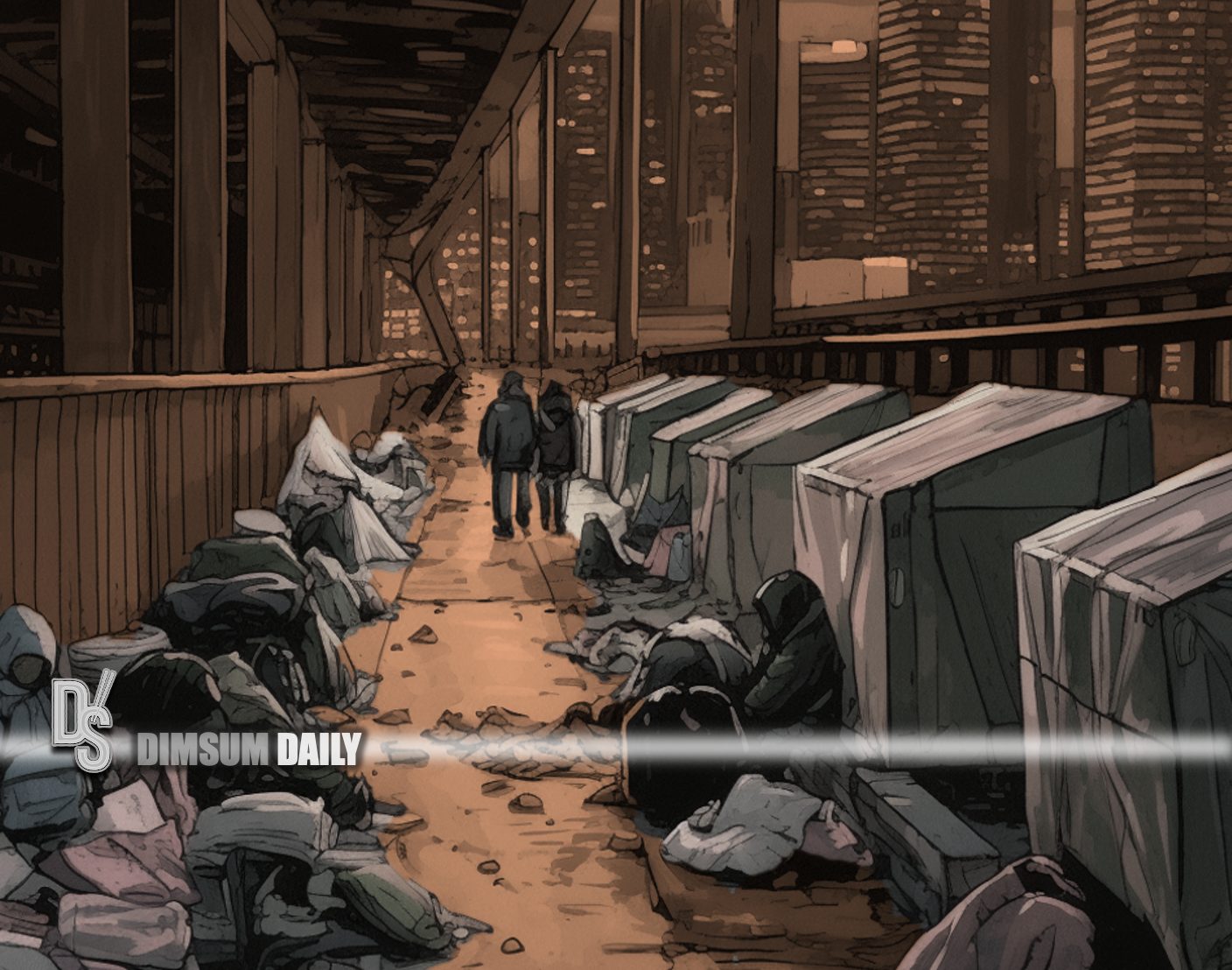
24th November 2024 – (Hong Kong) The sharp contrast between official statistics and ground reality in Hong Kong’s homeless population reveals a troubling pattern of institutional denial and inadequate response to a growing social crisis. While the Social Welfare Department reports a dramatic decrease in registered street sleepers to 606 as of October 2024 from 795 in the previous year, advocacy groups estimate the actual number could exceed 1,500, highlighting a large discrepancy that demands closer scrutiny.
This statistical disparity emerges against a backdrop of economic challenges that logically should be increasing, not decreasing, homelessness. Post-pandemic recovery has been slower than anticipated, and the influx of mainland workers in sectors like construction and hospitality has further strained employment opportunities for local workers. Yet official numbers paint an improbably rosy picture that appears to minimize rather than address the crisis.
The emergence of “McRefugees” – individuals seeking overnight shelter in 24-hour McDonald’s restaurants – represents a particularly Hong Kong phenomenon that official statistics fail to capture. Research indicates that their numbers have increased six-fold since 2013 to over 330 people, with 70% actually having homes but unable to afford proper living conditions. This phenomenon underscores the complex relationship between homelessness and housing affordability in one of the world’s most expensive cities.
The geographical distribution of homelessness in Hong Kong tells its own story, with 47.5% of street sleepers concentrated in the Yau Tsim Mong district and 17.5% in Sham Shui Po. These areas, traditionally working-class neighborhoods, have become focal points for social welfare challenges as economic pressures mount.
Government responses have often prioritized cosmetic solutions over addressing root causes. The introduction of hostile architecture – from concrete spikes to decorative barriers – has forced many homeless individuals into increasingly marginal and dangerous spaces. A particularly controversial incident in December 2019 at Tung Chau Street Park highlighted the authorities’ sometimes heavy-handed approach, when officials removed homeless people’s belongings without the legally required 24-hour notice.
The resulting legal battle, concluding in March 2022 with a symbolic compensation of HK$101.10 to affected individuals, exemplifies the disconnect between bureaucratic processes and human needs. This approach appears to focus more on removing visible signs of homelessness than addressing its underlying causes.
The Social Welfare Department’s mechanisms for tracking homelessness reveal systemic flaws in the government’s approach. The complex registration process, requiring extensive personal information and medical history, deters many homeless individuals from officially registering. Social workers report that many potential registrants view the process as futile, believing government assistance will be minimal or nonexistent despite the paperwork burden.
This bureaucratic barrier creates a self-fulfilling prophecy: lower registration numbers enable officials to claim success in reducing homelessness, while the reality on the streets tells a different story. The government’s Computerised Street Sleeper Registry, while well-intentioned, captures only a fraction of the actual homeless population, leading to potentially misguided policy decisions based on incomplete data.
The evolution of Hong Kong’s homeless demographic presents another concerning trend. Unlike previous generations of street sleepers, today’s homeless population increasingly includes younger individuals, short-term homeless, and a diverse range of backgrounds. This shift reflects broader societal changes and economic pressures, particularly in housing affordability and employment stability.
Housing costs remain at the heart of Hong Kong’s homelessness crisis. With tiny subdivided flats costing upwards of US$1,700 per square foot, many working individuals find themselves priced out of proper housing. The government’s provision of 620 temporary accommodation places, including 228 NGO-operated short-term hostel spots, falls woefully short of meeting the need, even by official population estimates.
The “McRefugees” phenomenon particularly illustrates Hong Kong’s unique housing crisis. These individuals, often employed but unable to afford proper housing, represent a new category of hidden homeless. Their preference for air-conditioned McDonald’s restaurants over cramped, poorly ventilated subdivided flats highlights the inadequacy of Hong Kong’s housing options for its working poor.
Winter brings additional challenges, as evidenced by recent temperature drops below 12 degrees Celsius. While the government opens temporary shelters in 18 districts during cold snaps, these reactive measures fail to address the year-round nature of homelessness. The recent winter has seen particularly vulnerable individuals, including elderly residents without family support, struggling to find adequate shelter.
The government’s approach to homeless clearance operations has become increasingly aggressive. Recent installations of barriers, fences, and hostile architecture in popular sleeping locations have forced homeless individuals into more dangerous and isolated areas. This strategy of displacement rather than support has drawn criticism from advocacy groups and social workers who argue it merely relocates rather than resolves the problem.
The economic impact of mainland workers on local employment opportunities adds another layer to the homelessness crisis. With sectors traditionally employing local workers now increasingly staffed by mainland immigrants, many Hong Kong residents face reduced work hours or unemployment. This economic pressure particularly affects industries like construction, cleaning, and food service, where many homeless individuals previously found employment.
Legal frameworks surrounding homelessness also require scrutiny. While the Public Health and Municipal Services Ordinance grants authorities power to remove abandoned items, the requirement for 24-hour notice is frequently ignored, as demonstrated in the Tung Chau Street Park incident. This cavalier approach to legal requirements suggests a systemic disregard for homeless individuals’ rights and dignity.
The government’s social welfare spending, at just 0.6% of GDP, ranks among the lowest globally for developed economies. This minimal investment in social protection leaves vulnerable populations particularly exposed during economic downturns. The contrast with other Asian financial centres, which typically maintain more robust social safety nets, is stark.
Several policy reforms appear essential in the near term. First, the government must acknowledge the full scope of homelessness by improving data collection methods and accepting input from advocacy groups and social workers. Second, temporary shelter capacity must be significantly expanded, with a focus on dignified, long-term housing solutions rather than emergency accommodations. Additionally, the government should reconsider its hostile architecture policies, which merely displace rather than help homeless individuals. Resources currently spent on barriers and enforcement might be better directed toward support services and housing assistance. The role of social workers and NGOs requires strengthening, with increased funding and support for outreach programs. The current ratio of social workers to homeless individuals remains inadequate, limiting the effectiveness of intervention and support services.
Most critically, Hong Kong must address its housing affordability crisis through more aggressive public housing development and rent control measures. The current wait times for public housing, often exceeding five years, leave many vulnerable to homelessness in the interim.