























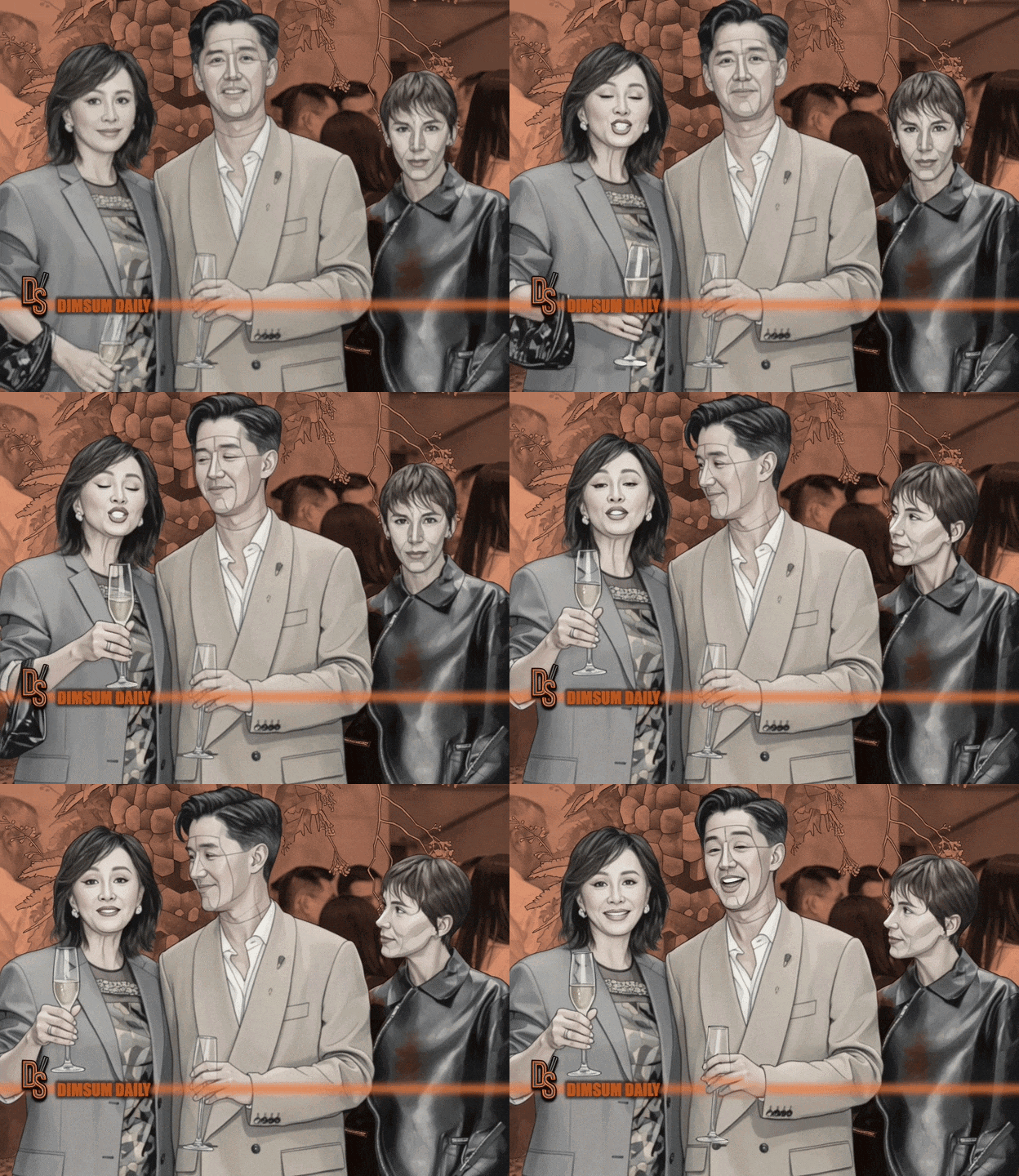
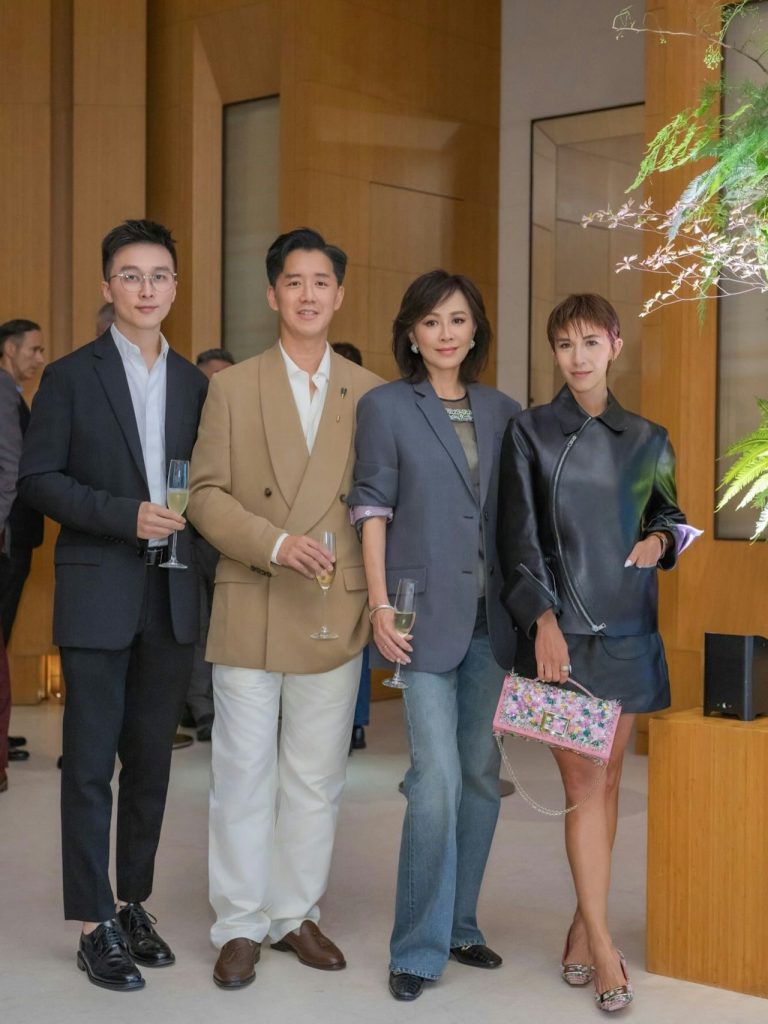
30th August 2026 – (Hong Kong) A distinctive theatre plays out atop Hong Kong’s social ladder, and it was on full display this week when actress Carina Lau escorted her newly minted architect nephew, Jeff Lau, to the twenty‑fifth-anniversary party for André Fu Studio.
Fu, grandson of the late Macao gaming figure Fu Tak-iam and a Cambridge-trained designer who built The Upper House and The St. Regis Hong Kong on genuine talent rather than surname, was celebrating a quarter century of work alongside the launch of his Assouline monograph. What deserves a closer look, however, is not the guest of honour but the sartorial choreography of those who came to be seen celebrating him.
The temperature outside hovered around 33 degrees, with the kind of humidity that turns Central into a steam room by mid‑morning. Inside, as the photographs show, Victoria Tang‑Owen wore a black leather jacket from an older Bottega Veneta collection, paired with a Roger Vivier bag from the current season. Leather. In late August. In Hong Kong. The choice invites a pause, because it hints at something the wearer may not have meant to disclose.
The logic behind dressing for winter in a subtropical summer is not, as it turns out, complicated. It is a quiet declaration that one’s feet do not touch the pavement. The truly insulated move from an air-conditioned penthouse to an air-conditioned car to an air-conditioned lobby, spending perhaps ten seconds in the actual climate of the city they live in. For this crowd, the weather is an abstraction, a thing that happens to other people who wait for buses. To wear leather to a cocktail party is therefore not a fashion misstep. It is a boast dressed up as a garment, a way of announcing that the outside world, with all its sweat and inconvenience, simply does not apply.
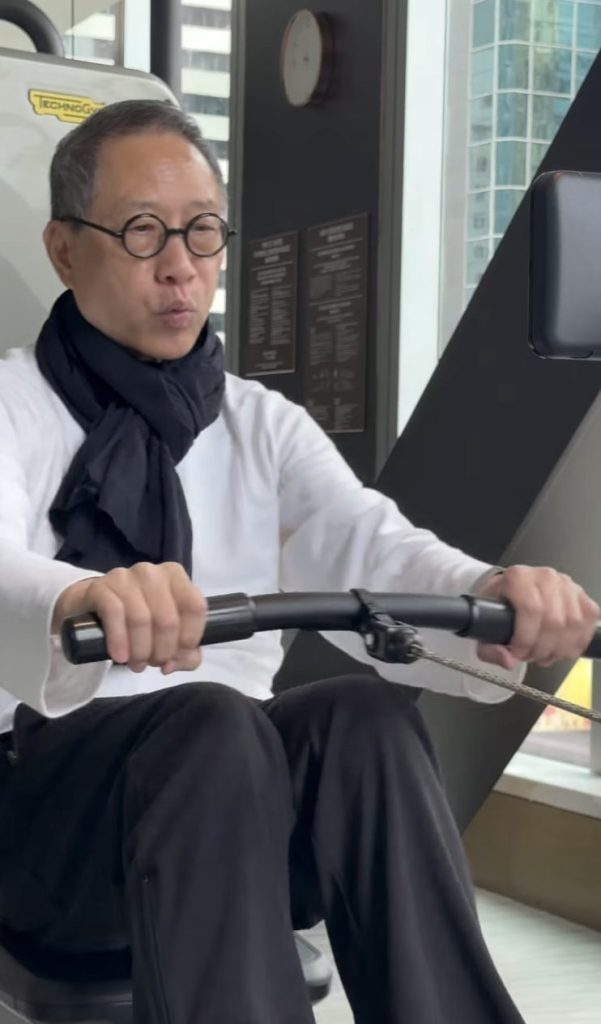
This is not an isolated eccentricity. The veteran designer Alan Chan recently shared a video of himself working out in the gym at The St. Regis, complete with long sleeves and a scarf draped around his neck. One might ask why a man exercising indoors requires a scarf. One might also ask why the workout needed to be broadcast at all. Both questions point to the same answer. The scarf is not for warmth and the video is not for fitness. Both are for us, the audience, who are meant to register the location, the brand of the moment, and the effortless superiority of a life lived above the heat.
The psychology here is not new, and it is not even subtle. Kanye West, never a man to leave a thought unshared, explained his own habit of dressing for winter in summer with characteristic bluntness in 2022. “Sometimes I dress like it’s winter when it’s hot cause my outfit hot,” he wrote. “I’ma sweat before you catch me looking regular.” Stripped of the capital letters, this is perhaps the most honest articulation of conspicuous consumption ever offered by a celebrity. Comfort is irrelevant. Physical discomfort is, in fact, the point, because visible suffering in the name of appearance is proof that appearance matters more than sensation. The willingness to sweat becomes a form of currency.
Economists have a tidy phrase for this – conspicuous consumption, the purchase and display of goods not for their use but for the status they broadcast. Marketers prefer the gentler term “social proof,” the idea that we validate our choices by seeing them reflected in the people we admire. Both concepts describe the same transaction. The clothing is a signal, the event is the broadcast tower, and the rest of us are the intended receivers. What is being sold is not style but membership, the reassurance that one belongs to a tier where the ordinary rules of climate and comfort have been suspended.
There is a further irony worth sitting with, given who was in the room. Victoria Tang-Owen is the daughter of the late Sir David Tang, the Shanghai Tang and China Club founder who was, in the years after his death in 2017, accused in high court writs of improperly transferring funds from his own ventures. China Club sought HK$115 million from his estate, alleging over HK$100 million had been moved into his personal accounts or those of related companies. Cipriani Hong Kong, which he cofounded, alleged a further HK$35 million and several missing artworks. The estate, in other words, carries a documented association with the quiet siphoning of institutional money into private hands. And yet the performance of luxury continues, unbroken, generation to generation, because the appearance of wealth must be maintained regardless of the machinery beneath it.
This in no way detracts from André Fu, who by all accounts secured his standing through craft rather than lineage. But the party around him functioned as a mirror, and what it reflected was a class so removed from the physical reality of its own city that it treats a leather jacket in August as a reasonable social decision. The message being sent is clear enough. It is simply not as flattering as those sending it seem to believe.