





























28th July 2025 – (Hong Kong) Hong Kong residents have a penchant for seafood, but some individuals exhibit allergies to shellfish, especially crabs, leading to severe allergic reactions. Research from the Faculty of Medicine at The Chinese University of Hong Kong has unveiled that the six common types of crabs in the local market a total of 11 allergens, with eight being newly identified triggers. Moreover, the team discovered unique allergens in the King crab, revealing that it is not a true “crab.” These findings are poised to advance precise diagnosis and personalised treatments for food allergies. The related research has been published in the international medical journal “Allergy” and presented at two international allergy conferences.
Globally, approximately 2% of the population suffers from shellfish allergies, encompassing crustaceans like shrimp, crabs, scallops, mussels, clams, lobsters, oysters, and abalones. Shellfish allergies constitute a primary cause of anaphylactic shock among adolescents and adults in Hong Kong. Following shrimp, crabs rank as the second most common allergen, triggering reactions such as urticaria, angioedema, wheezing, and in severe cases, anaphylactic shock.
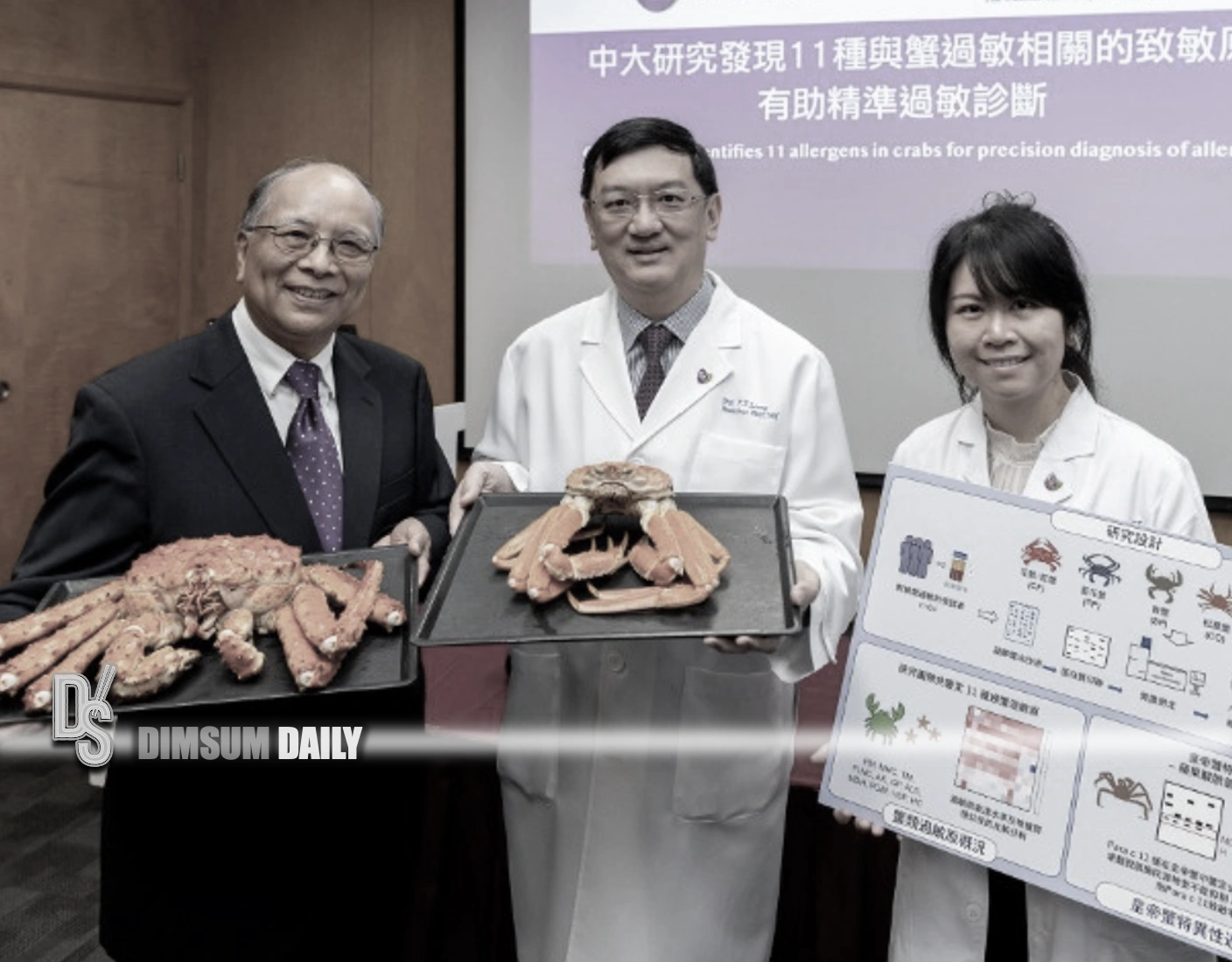
The CUHK team analysed six commonly found crab species in Hong Kong, including flower crabs, blue swimmer crabs, mud crabs, Japanese blue crabs, Chinese mitten crabs, and horseshoe crabs. They extracted muscle proteins from the claws of each crab and analysed the sources of allergic reactions with serum samples from 64 crab-allergic patients. The results revealed a total of 11 crab allergens, with eight being newly discovered triggers.
Miss Chow, 17, had been allergic to fish since childhood but had never experienced allergies to crab seafood. During a trip to South Korea two months ago, after consuming several raw octopus legs and soy sauce crab for the first time, she developed allergic symptoms like swollen lips, throat obstruction, and dizziness within 5 to 10 minutes. Due to the severity of her reaction, the allergy team immediately prescribed an EpiPen for her and analysed her shellfish allergy status from past blood samples, discovering an antibody response to hemocyanin, a protein commonly found in flower crabs and Chinese mitten crab roe.
Another breakthrough in the research was the identification of a specific allergen, “malic acid dehydrogenase,” in the horseshoe crab, which exhibited a high allergen rate of 41.4%. Professor Chu Ka-Hou, retired from the Faculty of Life Sciences at CUHK, stated that the horseshoe crab does not belong to the true crab species but evolved from the ancestors of hermit crabs, displaying distinct biological protein structures from other crab species. The team successfully registered this allergen as “Para c 11” and included it in the allergen naming database of the World Health Organisation and the International Union of Immunological Societies (WHO/IUIS). Professor Leung Ting-fan from the Department of Paediatrics at CUHK Medical School noted that this research, consolidating allergen data for the six most commonly consumed crabs, will aid in providing more comprehensive and precise personalized treatment plans for seafood-allergic patients, thereby avoiding unnecessary dietary restrictions.