






























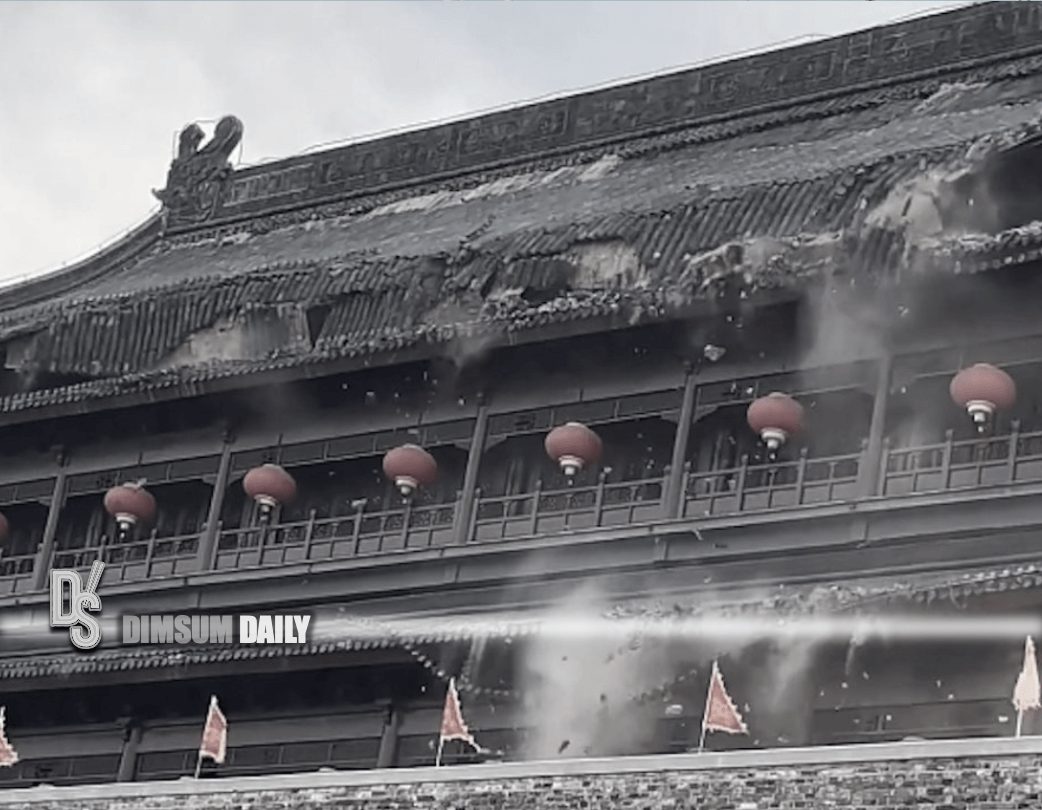
20th May 2025 – (Zhongdu City) On 19th May a major portion of roof tiles from the Mingzhongdu Drum Tower in Fengyang County, Anhui Province, collapsed, raising concerns over the structural integrity of the historic site and the quality of its recent renovation. Fortunately, no injuries were reported in the incident. Local authorities confirmed that the Drum Tower had undergone extensive repairs, completed in March 2024, at a cost of RMB 3.41 million.
The Drum Tower, originally built in 1375 during the Ming Dynasty and reconstructed in 1995, has faced recurring structural issues, including tile dislodgements and damaged eaves since 2017. The growing safety risks prompted local officials to launch a comprehensive restoration project in 2023. Following a public tender process, project design, construction, and supervision teams were appointed in May 2023, with work commencing in September of that year. Renovation efforts included repairing the double-eaved roof, replacing damaged tiles and beams, and reinforcing safety features such as second-story railings.
In the wake of the incident, Fengyang County activated its emergency response protocol to ensure public safety. Crowds gathered at the site were quickly evacuated, and safety barriers were installed by 11pm to prevent further risks to bystanders. The county’s Cultural and Tourism Bureau reported that the collapse occurred at approximately 6.30pm and involved one side of the roof.
To address the situation, the county government established a dedicated investigative team and directed the project’s design, construction, and oversight firms to inspect the site alongside independent experts. The investigation will assess potential flaws in the renovation process and determine accountability.
Known locally as Zhongdu Qiaolou, the Mingzhongdu Drum Tower holds significant historical value as part of the old city district of Fengyang. While the original structure was largely destroyed during the Qing Dynasty in 1853, the tower’s base was designated a provincial key cultural relic protection unit in 1989. Its reconstruction in 1995 aimed to restore its former architectural glory, blending historic preservation with modern engineering.