



















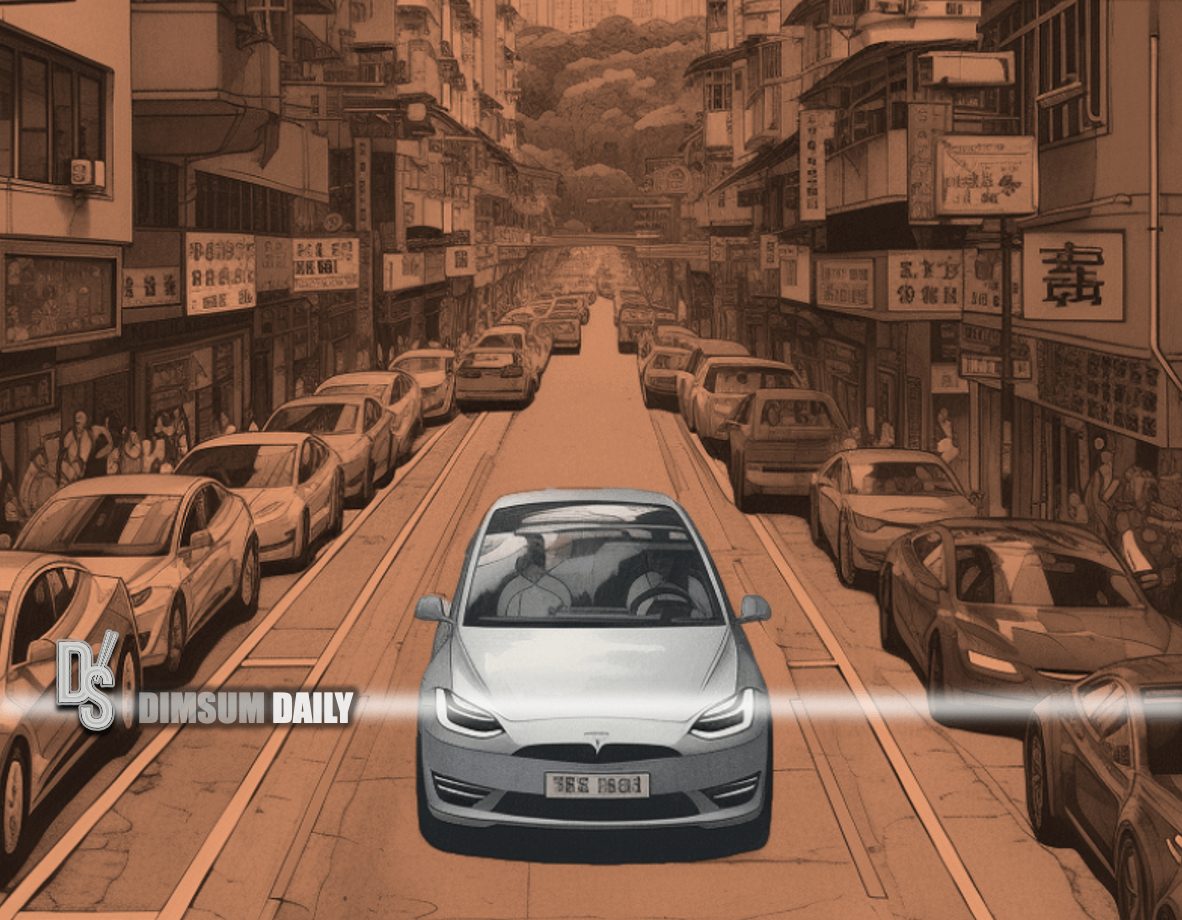
20th April 2025 – (Hong Kong) A casual observer of Hong Kong’s traffic might be forgiven for thinking Tesla owns the city’s roads. The American electric vehicle manufacturer’s cars are so ubiquitous that local drivers joke about every accident involving a Tesla – when one isn’t being rear-ended, it’s likely colliding with another. This automotive monoculture reflects Tesla’s early dominance of Hong Kong’s EV market, where its vehicles still comprise nearly half of all-electric cars registered. But beneath this surface of Tesla supremacy, seismic shifts are occurring as Chinese manufacturers aggressively challenge the status quo with competitively priced, technologically sophisticated alternatives.
The statistical reality confirms the visual impression. Of Hong Kong’s approximately 110,000 registered EVs – representing 12.3% of the city’s total vehicles – Tesla accounts for an astonishing 47% share. This concentration creates bizarre scenarios where Tesla models appear disproportionately in both luxury car parks and police accident reports. The company’s vehicles have become such constant fixtures in collision reports that some traffic officers privately refer to certain intersections as “Tesla tinderboxes.” This saturation stems from Tesla’s first-mover advantage and government policies that initially favored the brand, but market dynamics are changing rapidly.
Chinese automakers have identified Hong Kong as a critical beachhead in their global expansion strategies. The city’s unique combination of affluent consumers, compact geography, and right-hand drive configuration makes it an ideal testing ground for brands preparing to enter other Asian markets. BYD, Xpeng, Zeekr and other Chinese manufacturers have flooded Hong Kong showrooms with models spanning every price segment, from budget-friendly HK$160,000 compact SUVs to luxury vehicles rivalling Tesla’s premium offerings. The results are striking – Chinese brands’ market share has nearly doubled from 16% to 30% in just twelve months, according to Inchcape analysis of Transport Department data.
Several structural advantages fuel this Chinese EV offensive. Unlike Tesla’s standardised global offerings, mainland manufacturers tailor vehicles specifically for Hong Kong’s challenging urban environment. Extended-range batteries address charging anxiety in the city’s notoriously competitive parking landscape. Compact dimensions suit narrow streets while maintaining interior space crucial for Hong Kong’s chauffeur-driven luxury market. Perhaps most importantly, Chinese brands leverage their domestic supply chains to undercut Tesla on price while matching or exceeding its technology – the HK$229,800 GAC Aion Y Plus offers similar range to a base Model Y at nearly 40% lower cost.
The geopolitical dimension looms large over this automotive transition. As U.S.-China trade tensions escalate, Tesla finds itself caught in the crossfire. Elon Musk’s recent admission that Trump’s tariffs have “significant” impact on Tesla operations highlights the company’s vulnerability. Meanwhile, Chinese brands benefit from Beijing’s strategic support and Hong Kong government policies favouring domestic manufacturers. The “one-for-one” replacement scheme, offering substantial subsidies for trading in fossil fuel vehicles for EVs, disproportionately benefits Chinese models with their lower pre-subsidy price points.
Tesla’s cultural cachet in Hong Kong reveals signs of erosion. Where the brand once represented cutting-edge Western innovation, consumer focus groups now describe it as “predictable” and “ubiquitous.” Safety concerns percolate through online forums after several high-profile battery fires, while Chinese brands cultivate images as technologically equivalent but more attuned to local preferences. This shift manifests in corporate fleet purchases, where taxi operators and delivery companies increasingly favour Chinese EVs for their customised business solutions and extensive after-sales support networks.
With over 30 Chinese EV models now approved for Hong Kong roads and more entering monthly, Tesla faces a multi-pronged assault on its dominance. Industry analysts predict the American manufacturer’s market share could halve within three years as mainland brands leverage their advantages in pricing, customisation and political tailwinds. For Hong Kong drivers, this means finally seeing something other than Teslas in their rearview mirrors – and possibly fewer of them in accident reports as well. The city’s streets, long dominated by a single electric vision, are becoming a more diverse and competitive mobility ecosystem.