


























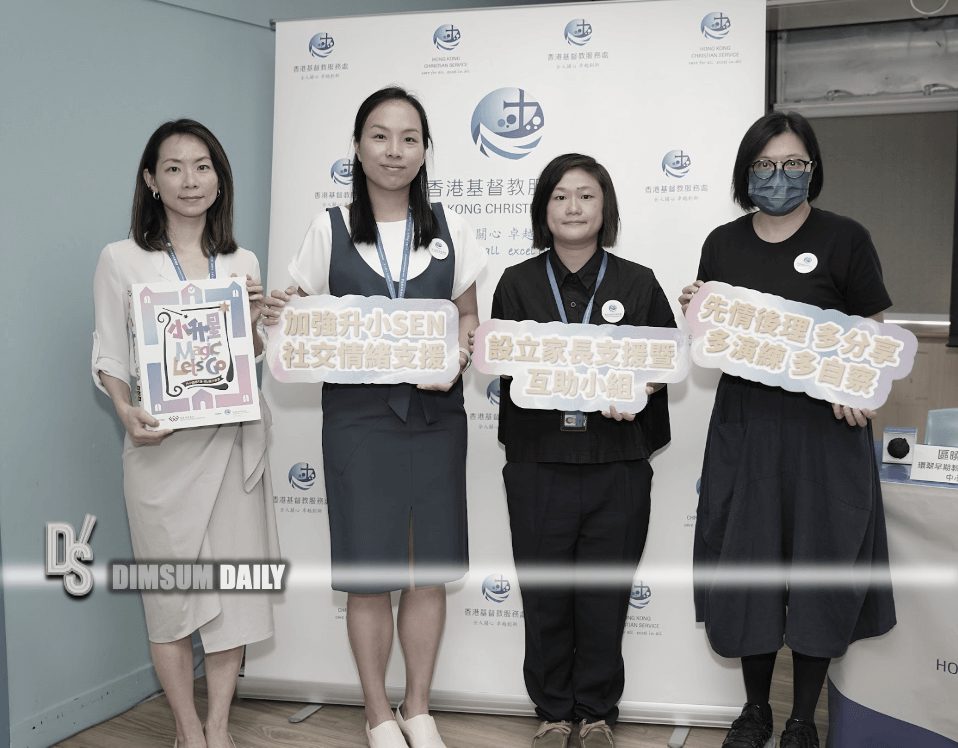
29th August 2023 – (Hong Kong) A recent survey conducted by the Hong Kong Christian Service (HKCS) has shed light on the crucial role of social-emotional skills in the lives of children with special educational needs (SEN). The survey findings indicate that higher levels of social-emotional skills not only lead to improved academic performance but also reduce the pressure faced by these children and their parents. With the number of SEN students in Hong Kong doubling over the past decade to nearly 60,000, it is imperative that the needs of these children are recognised and addressed.
The survey, titled ‘Social and Emotional Support for SEN Children Adapting to Primary School,’ involved interviews with 347 parents of SEN children and 158 professionals serving SEN children. The results revealed that both children and parents face immense pressure when it comes to adapting to primary school. To alleviate these challenges, HKCS recommends that the government, schools, and pre-school rehabilitation services place a stronger emphasis on social and emotional support within the primary school adaptation program.
Background Information
The questionnaire administered to parents primarily attracted female respondents, with 57.6% falling in the age range of 31 to 40. As for the professionals who participated in the survey, they included principals, teachers, social workers, and therapists, among others. A significant portion (60.1%) of these professionals had at least five years of experience working with SEN children.
Results and Analysis
- Weaker Self-management Performance and Difficulty in Staying Calm
The survey revealed that the average scores for ‘interpersonal skills’ and ‘self-management performance’ among SEN children were 56.7 and 49.3, respectively, out of a maximum score of 100. In terms of self-management performance, the three most common difficulties reported by SEN children were the inability to calmly resolve disputes with classmates, to stay calm when teased, and to stay calm when disagreeing with others.
- Social-Emotional Skills Enhance Academic Performance and Reduce Stress
Concerning learning attitudes, the survey identified the three most prevalent challenges faced by SEN children as the inability to keep up with learning, to answer teachers’ questions in class, and to concentrate during lessons. The survey findings indicate a positive correlation between higher levels of social-emotional skills and improved academic performance. Moreover, due to the transition to primary school, 34.3% of SEN children experienced ‘very high’ pressure to excel academically, with 18.4% even refusing to attend school. Parents also reported significant pressure in caring for their children, with 36.0% experiencing ‘very high’ levels of pressure and 27.1% facing persistent sleep problems. However, the survey showed that SEN children with stronger social-emotional skills were better equipped to handle the stress associated with learning and parental care.
- Primary School Adaptation Program Lacks Social-Emotional Support
The primary school adaptation program for SEN children, which is currently provided by kindergartens, fails to allocate sufficient teaching time to ‘social development’ (60.5%) and ’emotion management’ (65.0%), according to 60% of professionals surveyed. In fact, 62.4% of professionals stated that schools primarily focus on ‘conventional learning,’ neglecting the crucial aspect of social-emotional development. Consequently, SEN children often lack the necessary time and resources to develop these essential skills.
Case Studies
- Nga Yin, a working mother, shared the story of her six-year-old son, Long, who has autism spectrum disorder and developmental delay. Long’s pre-school education was primarily impacted by the COVID-19 pandemic, leading to weaker social-emotional skills. Since starting primary school in the academic year 2022/23, Long has struggled to make friends. Nga Yin recounted a distressing incident when Long had a dispute with his classmates over a seat on the school bus, which resulted in tears when he returned home. Such social difficulties are not uncommon for SEN children. Nga Yin expressed her shock and concern, stating, “I never imagined that Long would face such challenges. If the school could provide better support for his social-emotional skills during the transition to primary school, it would make his experience much more enjoyable.”
- Ning (pseudonym), a full-time mother, shared her experience with her son, Sing (pseudonym), who is in Primary 2. Sing was recently diagnosed with attention deficit and autism spectrum disorder. Ning noted that Sing’s emotions are often volatile, and his social-emotional skills require continuous support from a speech therapist. Ning highlighted the difference in attention and recognition given by Sing’s Primary 1 and Primary 2 teachers. While the former provided more support, resulting in improved emotional well-being and academic performance, the latter paid less attention to Sing, leading to increased emotional instability and a significant decline in academic achievements. Ning recalled an incident where Sing refused to return to school after the art teacher criticized his work. She hadto intervene and provide emotional support to help Sing overcome the situation. Ning emphasized the importance of consistent social-emotional support from teachers throughout a child’s academic journey.
Recommendations and Conclusion
Based on the survey findings, the Hong Kong Christian Service (HKCS) proposes several recommendations to address the social-emotional needs of SEN children during the transition to primary school:
- Strengthen social-emotional support within the primary school adaptation program: The government, schools, and pre-school rehabilitation services should allocate more teaching time and resources to social development and emotion management. This will help SEN children develop essential skills and cope with the challenges of primary school.
- Provide comprehensive teacher training: Teachers should receive training on understanding and supporting the social-emotional needs of SEN children. This includes strategies for promoting positive social interactions, conflict resolution, and emotional regulation. Ongoing professional development opportunities should be provided to ensure teachers stay updated with the latest practices.
- Foster collaboration between schools and parents: Schools should actively involve parents in their child’s education and provide them with the necessary support and resources. Regular communication and collaboration between teachers and parents can help create a conducive learning environment for SEN children.
- Increase resources for support services: Additional resources should be allocated to support services, such as speech therapists, occupational therapists, and counsellors, to provide individualized support to SEN children. These professionals play a vital role in helping children develop social-emotional skills and manage their emotions effectively.
In summary, the survey conducted by the Hong Kong Christian Service highlights the importance of social-emotional skills in the academic performance and well-being of children with special educational needs. By prioritizing social-emotional support within the primary school adaptation program and implementing the recommended strategies, it is possible to create a more inclusive and supportive educational environment for SEN children in Hong Kong.