































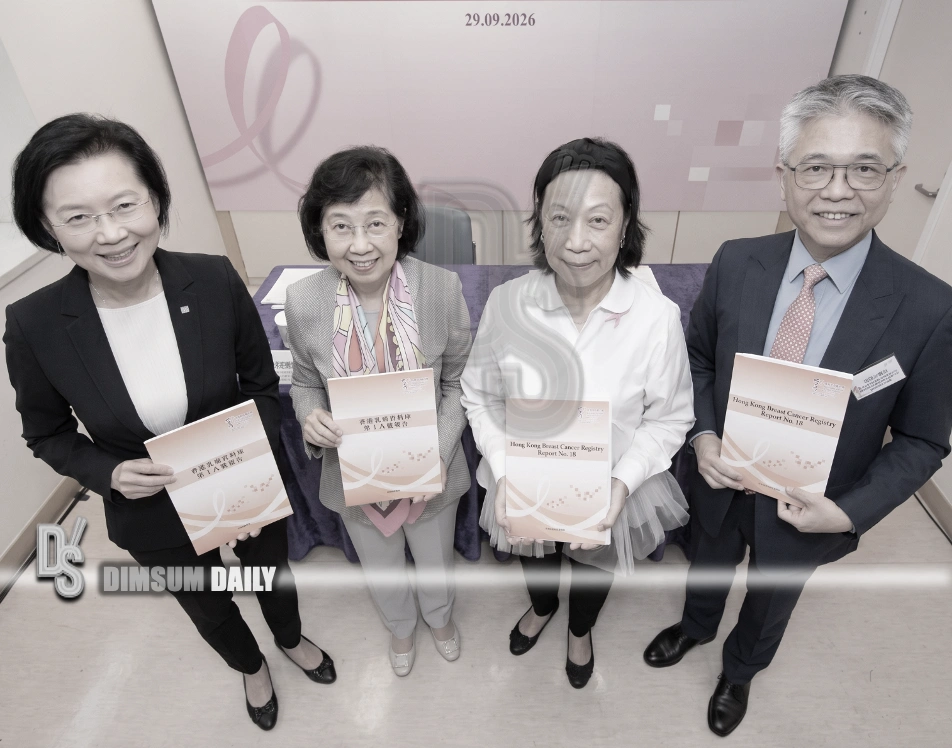
29th September 2026 – (Hong Kong) Women whose breast cancers are found by routine mammography fare far better than those diagnosed only after symptoms appear, the Hong Kong Breast Cancer Foundation said today, arguing that regular screening from the age of 40 could lift survival and cut long-term treatment bills by HK$770 million for every 100,000 women covered.
The foundation released Report No. 18 of the Hong Kong Breast Cancer Registry. It drew on 6,942 female breast cancer cases recorded between 2011 and 2015. Of those, 733 symptom-free women were classed as the “screening-detected” group after active X-ray screening; the remaining 6,209 were the “symptom-detected” group, typically tipped off by a lump they could feel. Late-stage disease (stages 3 to 4) made up just 3.3 per cent of the screening group, against 21.1 per cent among women found after symptoms. Screening cases also tended to have smaller tumours, lower rates of lymph-node involvement, and more hormone-receptor-positive, HER2-negative disease, while the symptom group more often had aggressive triple-negative cancers.
On treatment, 56.6 per cent of the screening-detected patients had breast-conserving surgery, compared with 32.6 per cent in the symptom group, and only 25.3 per cent of the screening cohort needed chemotherapy — fewer than among those found by symptoms. Professor Rina Hui Yee-man, a member of the registry steering committee and director of the University of Hong Kong’s Centre of Cancer Medicine, said most screening-found cases are early, so patients are more likely to keep the breast and less likely to face chemotherapy. Screening, she added, supports less invasive surgery and treatment, lifts overall 10-year survival and trims the cost of care.
Using Kaplan-Meier estimates, the screening-detected group’s 10-year overall survival reached 88.0 per cent — an absolute gain of 13.7 percentage points over the symptom-detected group. A separate retrospective look at 15,144 participants found average treatment costs for each mammography-detected patient were 28.4 per cent lower. Extrapolating that model, if 100,000 women began screening at 40, total treatment spending could fall by HK$770 million over time. Foundation founder and specialist surgeon Dr Polly Cheung said the work fills a local evidence gap on screening benefits and underpins the push for regular checks.
Honorary adviser Professor Emily Chan Ying-yang recalled being diagnosed with early breast cancer at a routine January exam this year. “I could feel nothing — no bleeding, no pain,” she said. “Without regular mammograms I would never have known.” Another patient in her sixties, Ms Ng, was found to have stage 0 disease in late 2025 through screening and said early detection spared her chemotherapy, radiotherapy and long-term drugs after surgery, easing both mental and money pressure. Foundation chairman Dr Eliza Fok urged women aged 40 or above to have clinical and mammography checks every two years so disease can be caught and treated early.