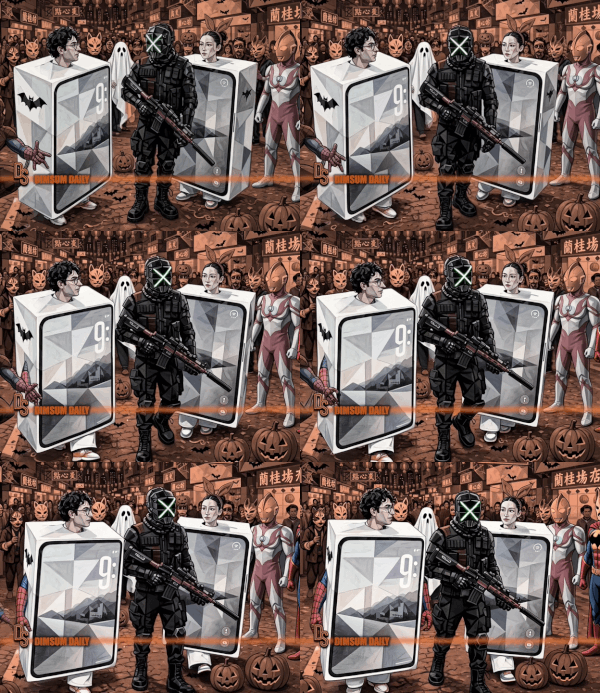
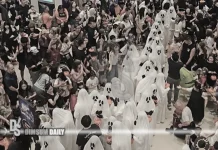





















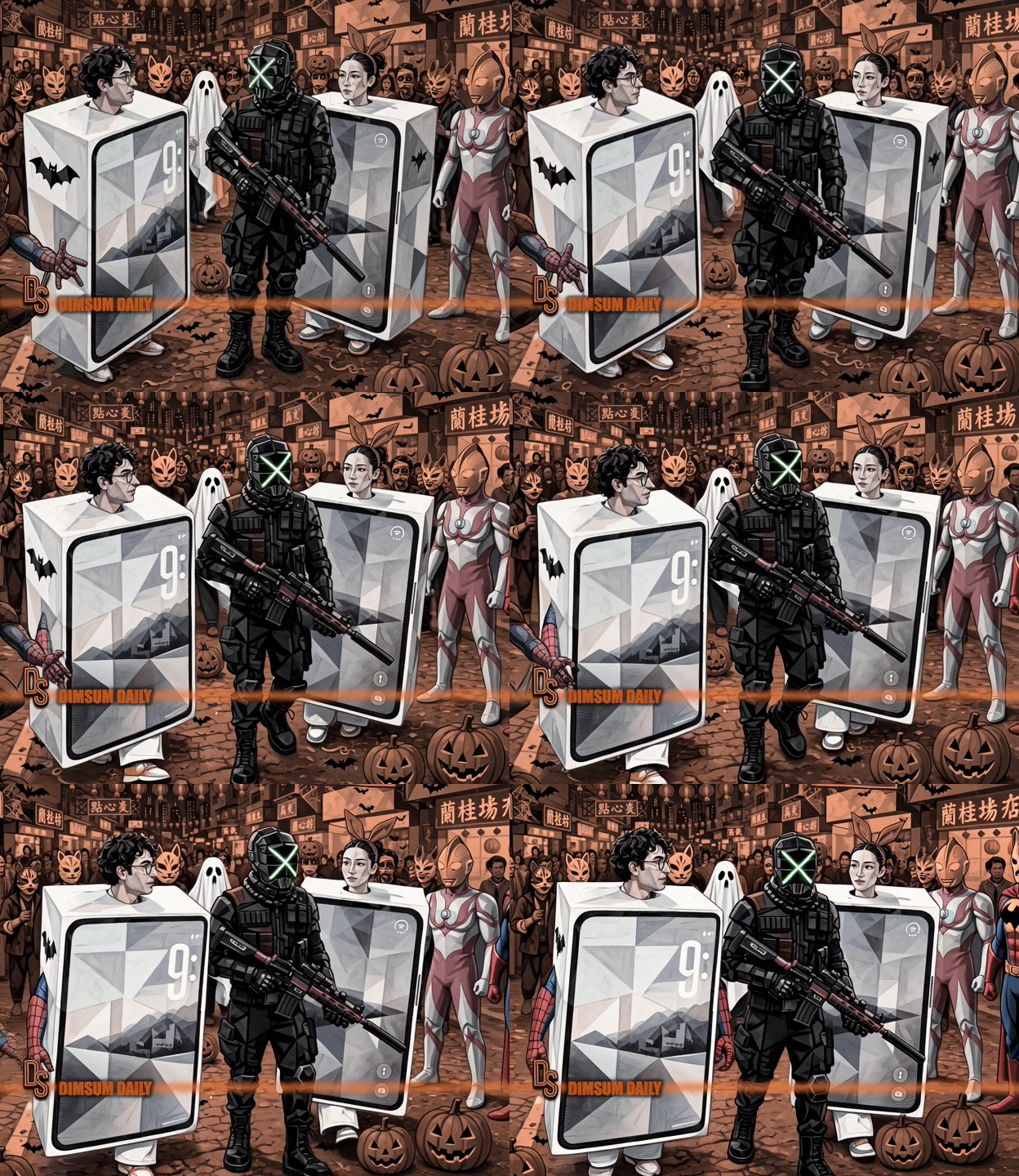
1st November 2026 – (Hong Kong) Stand still on a Hong Kong pavement on the last night of October and the city starts to explain itself. Several traffic cones wait at a crossing in Central. Two Spider-Men share a fishball skewer outside a Tsim Sha Tsui convenience store. A couple dressed as an iPhone Duo in LKF, folding screen and all, poses for photos while a banker, still in his suit trousers, pulls on a werewolf mask before heading up D’Aguilar Street. Cosplayers who have spent months on their outfits walk past toddlers in plastic fangs. Nobody stares for long. For one night the strange is normal.
For years, Halloween here stayed within fairly tight limits. It belonged to Lan Kwai Fong, to expatriate bars and to the two theme parks. This year, it spread well beyond them. Over the weeks leading up to 31st October, crowds filled Langham Place, the harbourfront at Tsim Sha Tsui East, Hung Hom and Kai Tak. Then the clips began arriving from places few city-centre residents would cross town for. Tin Shui Wai Ginza. Tung Chung. YOHO MALL in Yuen Long, where the flash dance parade drew such a crush that one viewer joked there was barely room left for the dancers. PopCorn and The LOHAS in Tseung Kwan O. The open space outside Tai Po Centre. The comment that kept appearing was some version of the same surprise: “Didn’t think somewhere this far out would be this packed!”
Many people live in flats where the sofa doubles as dining room and desk. Working hours are long, rents are high, and the pressure to look composed rarely lets up, whether at the office, on the MTR or in front of relatives. A costume gives people a rare permission. Behind face paint, a clerk can be a vampire, a student can be a joke about a phone, and a manager can be a traffic cone. People who would never sing in public will happily dance in a plaza if everyone around them is dressed as a zombie.
In Hong Kong, the mall is the town square. New towns and housing estates were planned around shopping centres, and for many families those atriums and podiums are the only large, covered, safe public spaces within walking distance. When PopCorn and The LOHAS ran their joint “Halloween Fun Day & Night” programme from 5th October to 1st November, they were doing what a village fair once did. At The LOHAS, posters noted, the crowd was mostly children whose parents had clearly worked hard on cute monster outfits. That detail matters. Homemade costumes take planning, time and pride. They are the mark of a community celebrating for itself rather than for a camera.
Tai Po offered the clearest example. Outside Tai Po Centre there was no stage and no organised programme, only neighbours who decided to turn up. A resident born in the district called the sight moving and asked why no television crew had come. The question was half complaint and half boast. New towns once dismissed as places people only went home to sleep are now home to second and third generations who grew up there. They no longer feel they must travel to Central to take part in the city’s life. They have brought the party home.
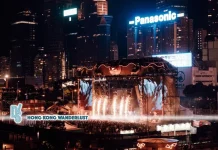
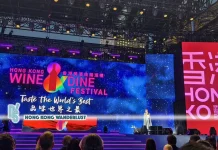
Then, there was a push from above. The Hong Kong Tourism Board’s first Hong Kong Halloween Month, under the slogan “Make the Streets Your Runway”, ran street parties every Saturday from 17th October. Central had giant eyeballs and a haunted jail. Langham Place turned a minibus into the “Mong Kok Haunted MiniBus”. Lan Kwai Fong held its Monster Mash. Disneyland and Ocean Park, which teamed up with Jackson Wang, provided the professional scares. Official backing told people that dressing up in public was welcome, and in a city that likes clear rules, that signal counts.
Halloween comes with almost no baggage here. It carries no religious duty and no family obligations. Nobody has to visit an aunt or cook a banquet. Anyone can take part on equal terms, which makes it unusually easy to join. Social media did the rest. Each clip from Yuen Long or Tung Chung dared the next district to match it.
Many Hongkongers now spend their weekends across the boundary in Shenzhen, where meals and entertainment cost less. Halloween gave them a reason to stay. A costume costs little, the plaza downstairs costs nothing, and the fun is close to home. Mall operators and shopkeepers will have noticed.
Halloween still is not a Hong Kong tradition on a par with Mid‑Autumn. It is young, commercial and partly staged. However, traditions often start like this, borrowed and then reshaped to fit local habits. Here the shape is already clear. It is dense, family-friendly, centred on malls and spread across the whole map. The costumes were loud, but what people wanted was something quieter: a few hours free of judgement, close to home, among neighbours. In a place that rarely has room to breathe, space appeared for one night when everyone agreed to pretend. By morning the masks were off, and what they revealed deserves more attention than the costumes.