






















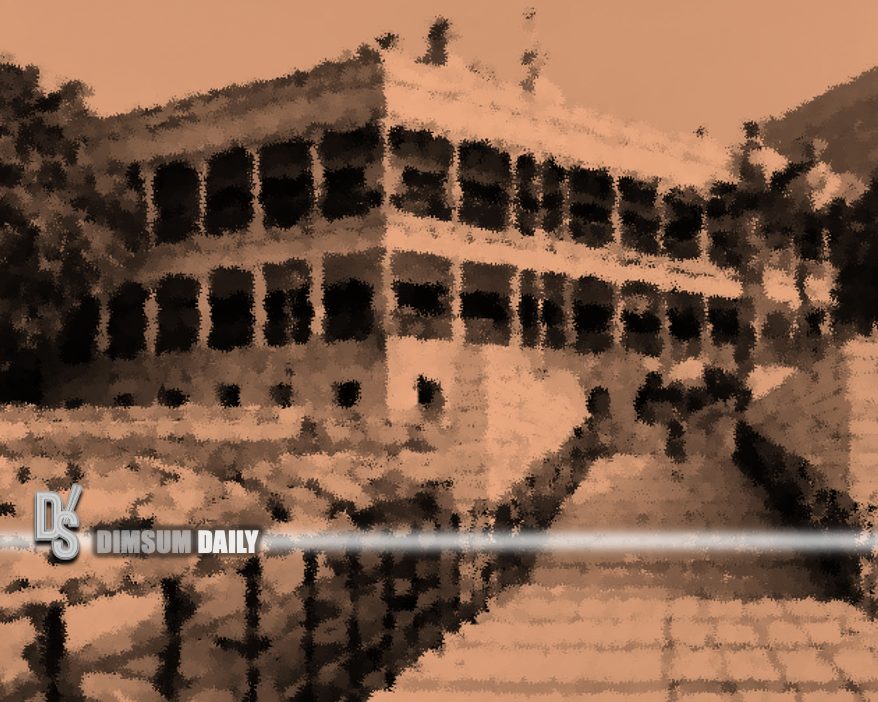
4th June 2024 – (Hong Kong) Stanley Murray House, formerly known as the Murray Barracks, is one of the buildings that bears the closest ties to Hong Kong’s modern history. Constructed in 1844, shortly after the British occupation of the island in 1841, the building has endured a remarkable journey of relocation, reconstruction, and ownership changes, ultimately becoming a commercial complex owned and managed by the Link REIT (0823.HK). However, the recent exodus of tenants, including the closure of H&M and various restaurants, has reduced the once-vibrant building to a state of virtual abandonment, mirroring the broader struggles facing Hong Kong’s economic transformation. The origins of Stanley Murray House can be traced back to the British military’s establishment of the Murray Barracks along the Central waterfront in 1841. The building initially served as officers’ quarters, and its history is intertwined with the city’s tumultuous past, including its use as the headquarters of the Japanese military police during the Japanese occupation and as a prison and execution site.
After the war, as Hong Kong’s economy and population expanded rapidly, the building was utilized by various government departments, serving as the headquarters of the Rating and Valuation Department in the 1970s and 1980s.
In 1982, the land on which Stanley Murray House stood was sold to the Bank of China for HK$120 million, leading to the construction of the current Bank of China Tower. Recognizing the historical significance of the building, the colonial government decided to dismantle it completely, meticulously cataloguing each of the more than 3,000 granite building components and storing them in a government warehouse, with the hope of one day reassembling the structure.
In 1990, the government selected a site in Stanley, along the waterfront, to recreate Stanley Murray House. The stored components were retrieved from the warehouse and painstakingly reassembled, with the reconstruction process completed in 1998, shortly after Hong Kong’s reunification with China.
Under the management of the Housing Authority, the revived Stanley Murray House initially attracted a mix of specialty restaurants, complementing the serene seaside ambience of Stanley. To alleviate the government’s fiscal deficit, the housing authority’s portfolio of over 180 commercial properties, including Stanley Murray House and the adjacent Stanley Plaza, was spun off and listed as the Link REIT (later renamed as Link REIT) in 2005.
Under Link REIT’s management, Stanley Murray House underwent a profound “commercialization.” In 2015, the company leased around half of the building’s floor space to the fast-fashion brand H&M, drawing criticism from some members of the public and conservation advocates who felt the move was incongruous with the building’s historic character.
In February 2022, Link REIT announced that Stanley Murray House and Stanley Plaza had received a purchase expression of interest from an unsolicited potential buyer. However, in July of the same year, the company cancelled the sale plans, citing difficulties for the potential buyer to visit Hong Kong due to the “border reopening” challenges.
Ironically, the potential buyer may have dodged a bullet, as the post-pandemic “revenge spending” boom in Hong Kong proved to be short-lived, leading to a wave of business closures. H&M, the major tenant of Stanley Murray House, shuttered its operations in the building in April this year, while a seafood restaurant on the first floor and a German restaurant on the second floor also recently closed down, leaving the once-vibrant complex largely vacant.
The current state of Stanley Murray House reflects the broader challenges facing Hong Kong’s leisure and tourism-related sectors. Once a popular destination for foreign expatriates and middle-class locals who enjoyed the seaside ambience, visiting for sunsets, seafood, and beer, Stanley and neighbouring areas like Repulse Bay and Discovery Bay have seen a decline in visitor numbers and spending.
While Repulse Bay still attracts some mainland Chinese tourists, their spending tends to be lower, with some even bringing their own bottled water, bread, and fruits, essentially contributing “zero consumption” to the local F&B and retail businesses. Stanley, in comparison, has seen an even more dramatic decline, with restaurants and shops struggling to stay afloat.
The plight of Stanley Murray House and its surrounding areas highlights the need for Hong Kong’s economic transformation. The building, which has witnessed the city’s evolution over the past 180 years, now finds itself in a state of flux, much like the Hong Kong economy. Just as Stanley Murray House requires a reinvention to find a new path forward, Hong Kong itself must embrace a strategic restructuring to address the changing market dynamics and visitor preferences.