













9th September 2026 – (Hong Kong) Hong Kong’s first astronaut, Lai Ka-ying, delivered a live lesson from China’s Tiangong space station to pupils in Hong Kong and Macao on Wednesday, marking another milestone in the city’s participation in the national space programme.
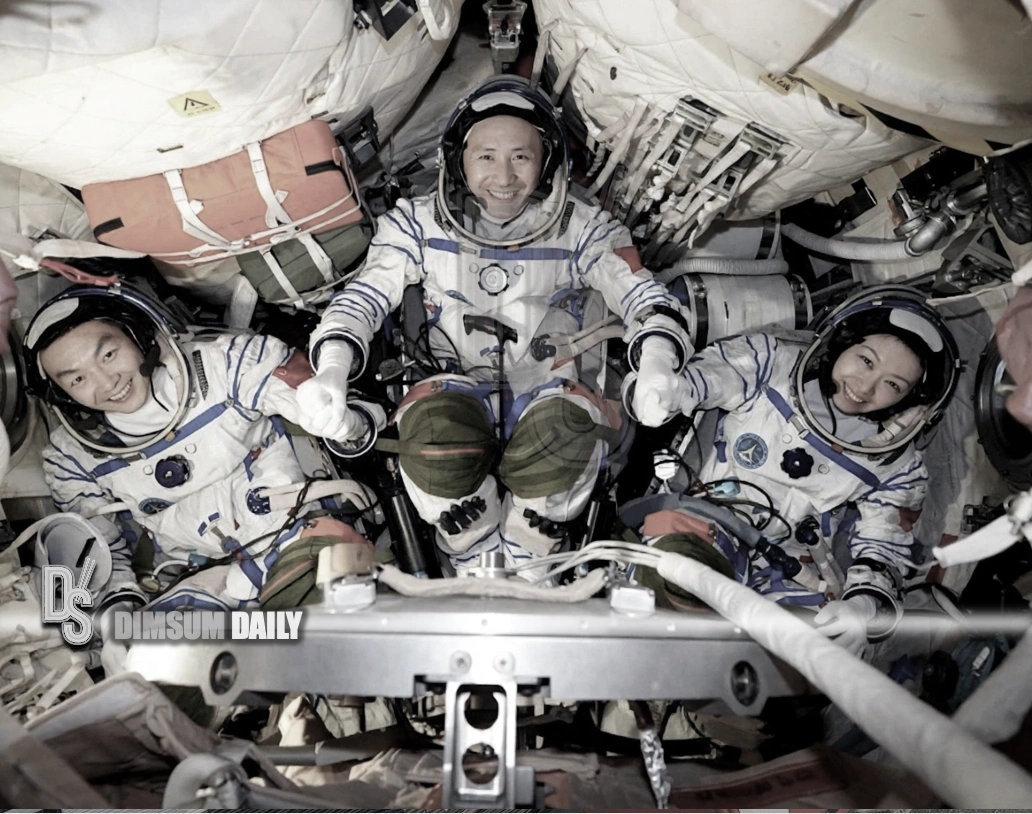
Lai was joined by Shenzhou-23 commander Zhu Yangzhu and crew member Zhang Zhiyuan for the special Tiangong Class, which began at about 9.50am and is set to last approximately 90 minutes. The astronauts shared details of their work and daily lives in orbit, conducted scientific demonstrations in a microgravity environment and answered questions from students.
The Hong Kong and Macao session was jointly organised by the governments of the two special administrative regions and the China Manned Space Agency. Hong Kong’s Education Bureau arranged for pupils and teachers at primary and secondary schools to watch the broadcast on campus, while the programme was also carried by government websites and local television platforms.
Chief Executive John Lee Ka-chiu thanked the agency for allowing young people in Hong Kong and Macao to communicate directly with astronauts and gain first-hand knowledge of space science. He said Lai’s achievement demonstrated that determined Hong Kong residents could play an important role in the country’s aerospace development.
Lee noted that the Tiangong station travels around Earth at approximately 7.7 kilometres per second. He said the live class provided pupils with a rare opportunity to observe scientific work in orbit and could encourage them to pursue ambitions in aerospace, innovation and technology.
During the lesson, Lai introduced the Multi-Spectral Imaging Carbon Observatory, known as MUSICO, which was developed by a team led by the Hong Kong University of Science and Technology. The instrument was transported to Tiangong aboard the Tianzhou-10 cargo spacecraft in May and became Hong Kong’s first scientific payload deployed on the national space station.
The lightweight observatory is designed to identify and monitor carbon dioxide and methane emission sources through high-resolution spectral imaging. Researchers expect its measurements to help locate major emitters, including power plants, and support the development of more targeted policies for reducing greenhouse gas emissions.
Lee said the government would continue promoting aerospace science education and public engagement activities to encourage younger generations to pursue their goals. Describing Lai as a daughter of Hong Kong flying proudly in space, he said her journey had brought the city closer to the nation’s growing space programme.
Tsuen Wan Public Ho Chuen Yiu Memorial College, Lai’s former secondary school, served as a focal point for the ground-based exchange. School principal Dr Lau Sui-yee encouraged pupils to draw inspiration from the astronaut’s determination, discipline and willingness to serve others.
Former teachers remembered Lai as a polite and inquisitive pupil who participated actively in school life. She took part in the traffic safety patrol, performed library duties and supported fellow students through peer-mentoring activities. They said she remained composed during public examination preparations and balanced her academic responsibilities with student activities through careful time management.
Lai’s former doctoral supervisor, Professor Chow Kam-pui of the University of Hong Kong’s School of Computing and Data Science, said her academic and professional background had prepared her well for the demands of spaceflight. He described her as diligent, responsible, patient and meticulous, with the teamwork and judgement required to manage sensitive experiments in orbit.
Lai studied computer science and information systems at the University of Hong Kong before completing postgraduate research in cryptography and digital forensics. Her doctoral thesis examined methods of profiling online copyright infringers, and her research involved the application of computer-forensic techniques to support law-enforcement investigations.
She joined the Hong Kong Police Force in 2012 as a technical specialist and later rose to the rank of superintendent. Lai was selected from Hong Kong applicants during the recruitment of China’s fourth group of reserve astronauts and subsequently completed intensive training at the China Astronaut Research and Training Centre in Beijing.
The 43-year-old payload specialist launched aboard Shenzhou-23 at 11.08pm on 24th May alongside Zhu and Zhang. The mission made her the first astronaut from Hong Kong to travel into space and placed her in charge of scientific and technical duties aboard Tiangong.
After spending more than 100 days in orbit, Lai used the Tiangong Class to connect her scientific work with classrooms at home. Her appearance offered students a direct view of China’s space programme while highlighting Hong Kong researchers’ expanding contribution to national aerospace missions.