



























29th June 2026 – (Hong Kong) Remember when artificial intelligence was supposed to take away our jobs and leave humans with nothing to do?
So far, that does not seem to be happening. The early evidence points to something stranger, harsher and more revealing. AI is not simply removing work. It is changing the density of work. It is raising the speed, widening the scope and exposing a new divide between those who merely use AI and those who learn to command it.
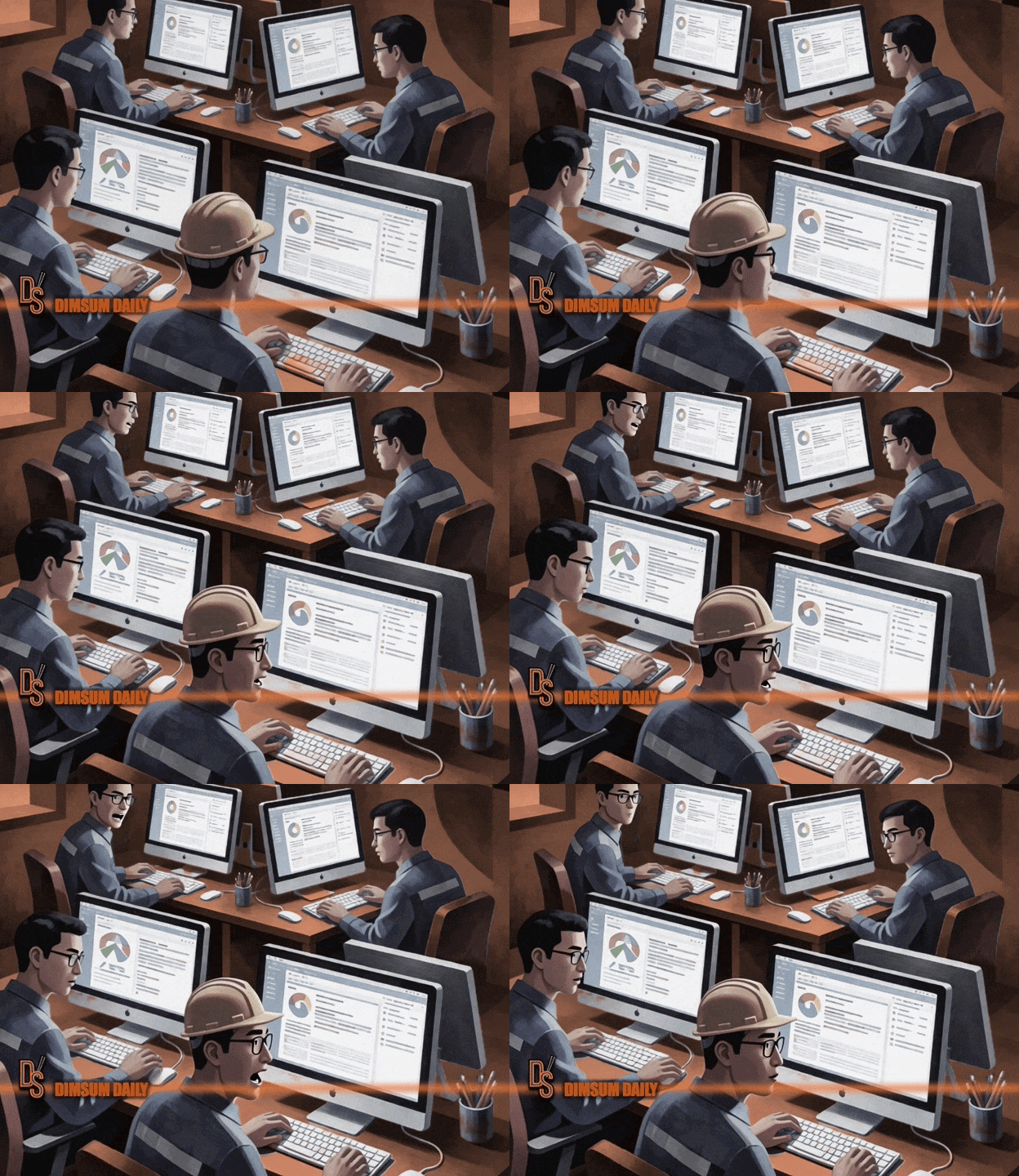
Researchers from ActivTrak analysed the digital activity of more than 10,000 workers and found that when people adopted AI, their work life became more intense, not less. Early adopters spent more than twice as much time on email, messaging and chat apps. Their use of business software rose by 94 per cent. Another line of research from UC Berkeley’s Haas School of Business found that workers using AI began taking on tasks they had previously outsourced, because coding, analysis and engineering work had become easier to attempt. They squeezed work into evenings, weekends, waiting rooms and stray minutes between obligations. They supervised several bots at once. They did not work less. They worked differently.
This should not surprise us. Time-saving technology rarely creates empty time. It often creates more activity. Faster transport did not make people travel less. It made them travel more. Smartphones did not reduce communication. They made people reachable everywhere. AI is following the same pattern. It reduces friction, then fills the space it opened.
The result is a split in the labour market that is often misunderstood. The first group treats AI as a chat box. They ask it to summarise, draft, translate, answer and polish. This is useful, up to a point. It can save minutes. It can make weak work look passable. It can help someone get through routine tasks with less strain. Yet it rarely changes the structure of the job.
The second group treats AI as an operating layer. These users do not stop at asking questions. They connect AI to files, workflows, databases, scripts, models and internal systems. They use it to build reports, convert spreadsheets into code, test assumptions, write small tools, automate tedious checks and examine problems from several angles. Many of them are not software engineers. Some are finance managers, operators, analysts, founders or executives who have simply realised that a little technical confidence now buys an extraordinary amount of leverage.
This is where the gap becomes astonishing. A person who only chats with AI gets assistance. A person who learns to orchestrate AI gets capacity. The first receives answers. The second builds systems.
In large companies, this distinction is becoming a strategic risk. Many enterprises have bought access to AI without creating the conditions for productive AI work. Employees are often confined to approved tools that sit politely inside office software but cannot touch the messy reality of the business. They cannot run a basic script. They cannot query a clean internal data warehouse. They cannot safely let an AI agent work inside a sandbox. They remain trapped between strict IT policy, legacy systems and tools that promise intelligence while delivering little more than a better search bar.
The irony is severe. A large corporation may have more money, more data and more staff than a smaller rival, yet the smaller company may move faster because its people can actually use the tools. A finance director in a locked-down enterprise may ask an AI assistant to fix a spreadsheet and receive nonsense. A finance director in a smaller firm may convert a complex workbook into Python, run simulations, connect market data and build a dashboard before lunch. The difference is not talent alone. It is permission, infrastructure and habit.
This is why the fear that AI will replace everyone is too crude. AI will replace tasks. It will compress roles. It will make some entry-level and back-office work harder to justify in its old form. In finance hubs such as Hong Kong and Singapore, recruiters already warn that graduate hiring in banking, insurance and support functions is slowing as employers automate repeatable processing work. The lower rungs of the white-collar ladder are under pressure because those rungs were built around tasks AI can now perform cheaply and endlessly.
Yet replacement is only one side of the story. The more important question is who becomes more valuable when AI becomes common.
The answer is not necessarily the person with the most credentials. It is the person with the strongest appetite for learning, judgment and agency. When intelligence becomes abundant, intention becomes scarce. Machines can calculate, synthesise and generate. They do not want. They do not care whether a product delights a customer, whether a model reflects reality, whether a sentence persuades a reader or whether a business deserves to exist. They do not consume the goods, services, stories, medicines, meals, homes, music, insurance policies or financial products that economies produce. Humans do.
That fact matters more than it first appears. Consumption remains human because desire remains human. AI may help design the shoe, price the loan, compose the advertisement, detect the fraud or analyse the portfolio. It does not need shoes, loans, advertisements, trust, status, beauty, comfort or meaning. The final market is still made of people with anxieties, ambitions, tastes, loyalties, fears and limited attention. The workers who thrive will be those who use AI to understand and serve human demand more sharply, not those who hide behind AI output as if output alone were value.
This is where early adopters gain their durable advantage. They are not simply faster. They are learning a new form of work while others are debating whether the old form will survive. They are discovering which tasks can be delegated, which require human judgment, which processes should be rebuilt and which outputs are not worth producing at all. They are developing taste under pressure. They are learning when to trust the machine, when to challenge it and when to ignore it.
There is also a danger for them. AI can create a crowded, fragmented working mind. The ActivTrak finding that focused work fell by 9 per cent among adopters should not be dismissed. The same tools that expand capacity can scatter attention. A worker supervising five agents, answering messages, reviewing drafts and checking dashboards may feel powerful while becoming mentally frayed. Productivity can become a room where every light is on and no one can see clearly.
The best AI users will therefore not be the most frantic users. They will be disciplined users. They will use AI for leverage, not surrender. They will ask for alternatives before conclusions. They will write their own view before requesting critique. They will automate routine work while preserving the difficult work that builds judgment. They will treat AI less as an oracle and more as a tireless assistant that still needs direction.
Companies face the same choice. They can impose AI from the top through slogans, licenses and consultancy decks. Or they can observe where real work happens and equip small teams to redesign their own workflows safely. That means internal APIs, secure virtual environments, clear data permissions, audit trails and training that goes beyond prompt tips. It means accepting that the people closest to the process often know best where AI can help.
The future of work will not be a simple contest between humans and machines. It will be a sorting mechanism among humans. Some will use AI to avoid thinking. Some will use it to appear productive. Some will use it to become more capable than their job description ever allowed.
The early adopters who thrive will not be spared because they resisted AI. They will thrive because they learned to bend it toward human purposes. In a world full of synthetic intelligence, the advantage will belong to those with sharper judgment, deeper curiosity and a clearer sense of what people actually need.