

























22nd November 2026 – (Hong Kong) At about 5.30pm on Saturday, a man walked out of the sea onto Hac Sa Beach in Macao. He was shaking with cold. His face was so pale and crusted with salt that his little daughter, Isla, looked at him blankly as if a stranger had come ashore. He had to lean in close before she knew who he was.
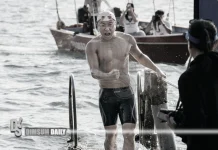
Before any of that, Alex Fong did something easy to miss. He pulled off his goggles, turned back to the water and waved his thanks to the boats and kayaks that had followed him for more than eight hours. Only then did he walk to the finish. It was a small gesture, and it says a lot about him.
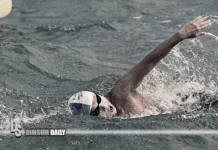
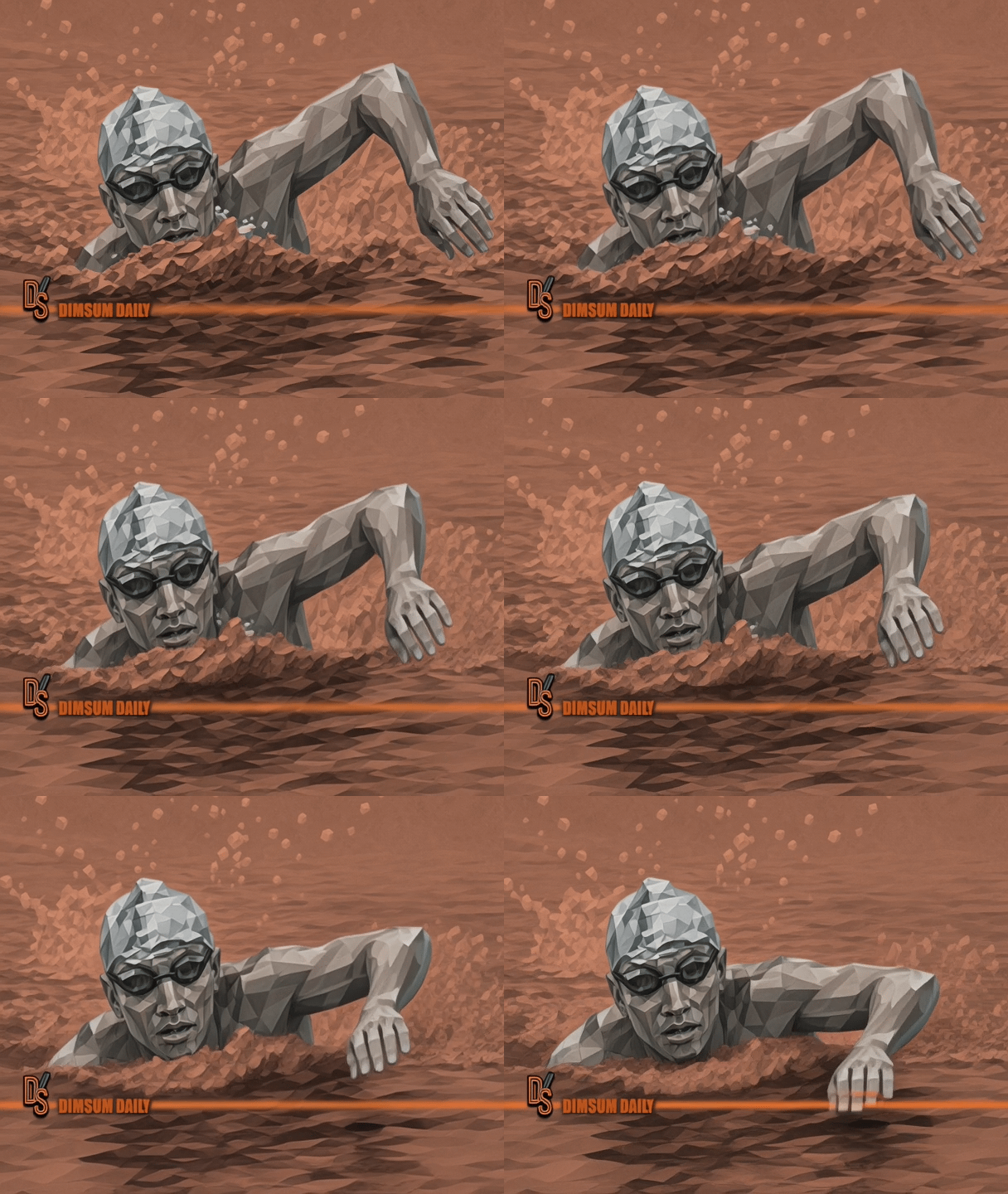
Fong is 46, a former Hong Kong Olympic swimmer who became an entertainer. He entered the water at Peaked Hill, on the western tip of Lantau Island, at 8.53am. Ahead of him lay 35 kilometres of open sea across the Pearl River Estuary. The route passed through Hong Kong, mainland and Macao waters, across strong currents and busy shipping lanes. The rules allowed no wetsuit, no flotation aid and no touching or climbing onto a support boat. He finished in 8 hours, 37 minutes and 24 seconds, about 20 minutes faster than he had predicted. Guinness World Records certified it as the fastest swim from Hong Kong to Macao by a man.
Only two people had made this crossing before him. Zhang Jian did it in about 11 hours in 2005, and Simon Holliday followed in 2014. Fong is now the third, the fastest and the oldest.
When he reached the beach, donations stood at HK$8,189,075. Organisers later said the total had reached the HK$10 million target. All of it goes to the InspiringHK Sports Foundation and Special Olympics Macau to pay for sports training for underprivileged children and children with special educational needs.
The swim had a real physical cost. Louie Lobo, a senior lecturer at the Education University of Hong Kong, said it used as much energy as running two marathons. Fong said the water turned bitterly cold for about four hours in the middle. His feet went numb and his head ached. At a drink break around the sixth hour he shook all over. Drifting off the straight line, he thinks he may have swum close to 40 kilometres. Hours after landing, it still hurt to swallow, and he could still taste salt.
Then he went to work again. That evening he appeared and performed at the Wave After Wave charity concert at Broadway Macau, a show he had organised himself. Ali Lee, Justin Lo, Wan Kwong, Bob Lam, Mandy Chiang and others performed. All ticket and sponsorship income goes, with no costs deducted, to six welfare and animal-protection groups in Hong Kong and Macao. One online comment asked whether he was even human. Another said he was the first person in Hong Kong’s history to swim to Macao to put on a show.
It is worth thinking about why this feels so unusual. Celebrity charity usually looks a certain way. A star posts a message, signs a cheque or turns up at a gala for an hour. These things help and should not be mocked. They rarely cost the celebrity anything they will feel the next morning.
People often argue online about whether celebrities owe young people a good example. Many say fame comes with no such duty. Fong did not join that debate. He answered it with his own story. His wife, Maple Yip, now pregnant with their second child, had begged him not to swim. Their children were young, she reminded him. He said he could not refuse. He spoke of “the feeling of being needed.” When someone needs you, he said, you have to show up.
Some will say this sets an unfair standard. Not every singer can cross an estuary. That misreads the lesson. Fong gave what he alone could give, the training and toughness of an Olympian. The singers that night gave their voices without pay. The lesson is about proportion, not distance. Real generosity means giving the thing that is hardest for you to give.
Lobo also noted that the Hong Kong–Zhuhai–Macao Bridge gave Fong a landmark to steer by. The image is worth holding onto. A man swam for eight hours beside a bridge that could have carried him across in under an hour. He chose the hard way so that children he will never meet could have an easier one.
The name of the concert explains the rest. Records do not last. Zhang’s 11 hours became Fong’s eight and a half, and someone will one day go faster. Somewhere in that cold middle stretch, Fong promised his wife he would never swim again. We should take him at his word. A good role model does not keep doing the impossible forever. He shows what it costs, pays that cost once and hands the work to whoever comes next. The children this money will train to swim, run and play are that next wave.