


























31st December 2025 – (London) The first signs of recovery emerged on Monday afternoon as limited rail services through the Channel Tunnel resumed, yet passengers travelling between the United Kingdom and continental Europe continued to face serious disruption, soaring air fares and considerable uncertainty.
A passenger on the 15:04 Eurostar service from London to Brussels – the first train to depart since the tunnel’s reopening – confirmed that the train had finally begun moving, marking a symbolic step towards the restoration of normal operations after earlier power supply problems.
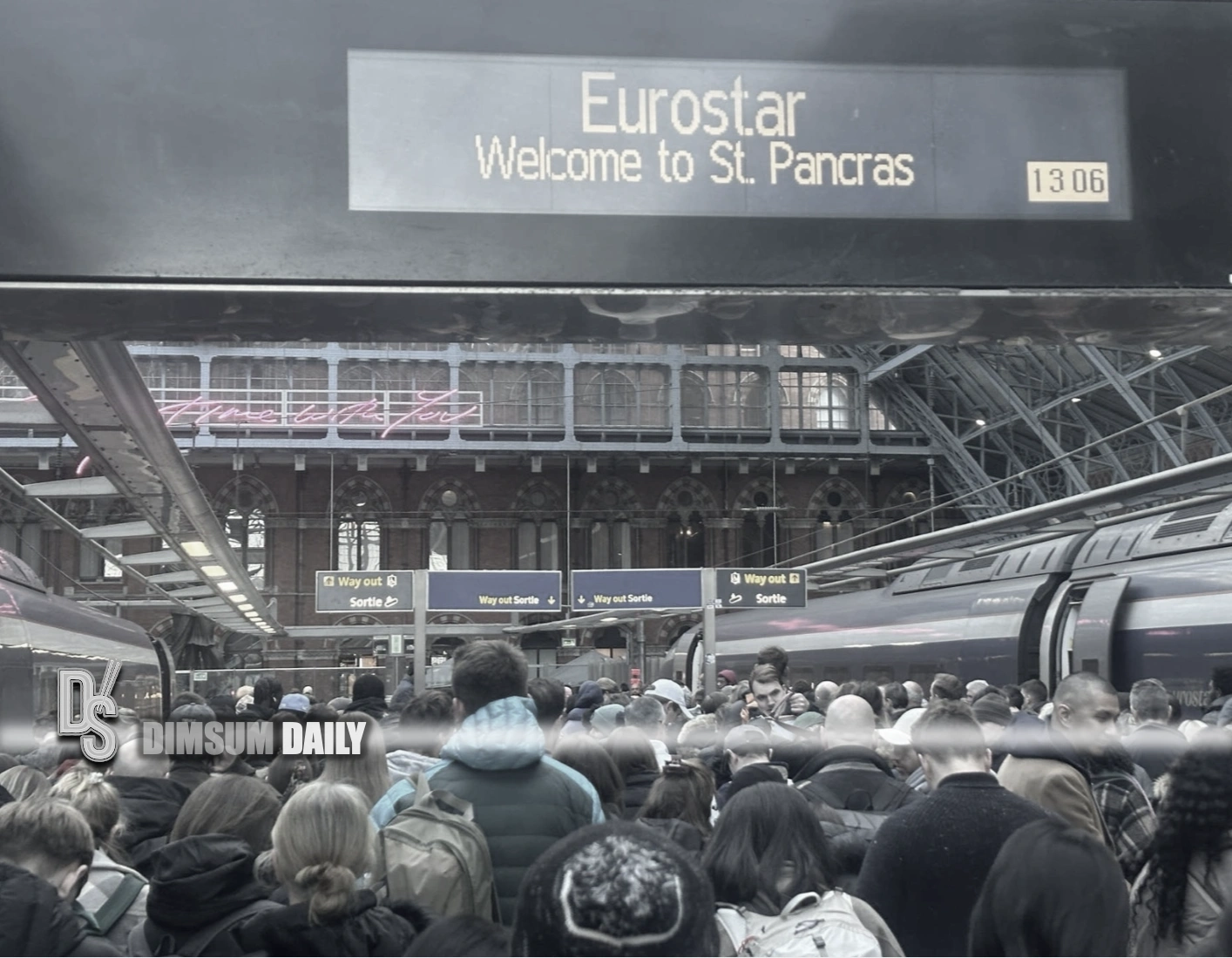
At London’s St Pancras International, the departure board that had been dominated by the word “cancelled” began to show more positive news. Reporters at the station observed growing queues for the 15:04 Brussels service, while new information indicated that the 17:31 and 18:01 services to Paris would open for boarding one hour before departure. The 18:04 Eurostar to Amsterdam was also displayed, giving some relief to travellers who had been stranded for much of the day.
However, difficulties in finding alternative routes remained acute. Monitoring by reporters of the Skyscanner flight comparison website showed that direct flights between London and Paris were rare and extremely costly. At one point, no direct services from London to Paris were visible, with only lengthy itineraries involving stopovers elsewhere in Europe and journey times of up to 25 hours. Shortly afterwards, a single direct Gatwick–Charles de Gaulle flight reappeared, only to disappear again and then return at a price of around £465. Direct flights for the following day were available but also priced in the high hundreds, with cheaper tickets again requiring long stopovers. A similar pattern was seen for flights from Paris to London, illustrating the pressure on capacity at short notice.
Stranded passengers in Paris described the financial and logistical strain. Denyse, a publican from Wiltshire who runs the Benett Arms in Semley, was attempting to return to Britain in time for New Year’s Eve after a birthday trip to Paris with her wife, Deborah. The pair, stuck for hours at Gare du Nord after their morning Eurostar was cancelled, reported that air fares were “going up and up” in real time, with one option reaching £1,000. With tickets for the following day still unavailable, they were considering a complex combination of trains to Calais or flights to Bournemouth or Bristol, despite their car being parked in London – a scenario reflecting the wider disruption faced by many travellers.
Road traffic near the Channel Tunnel vehicle terminal at Folkestone also experienced knock‑on effects. National Highways earlier reported delays of around 45 minutes on the M20 eastbound exit slip road leading to the LeShuttle terminal. Later in the evening, officials said congestion had eased, offering some respite to motorists.
On the cross‑Channel vehicle service itself, Eurotunnel announced that LeShuttle operations had “very gradually” resumed in both directions, but only on a single track and with “significant delays”. The operator stated that additional shuttle services would be added through the evening and into the following morning in an effort to clear the backlog and support the wider transport network.
Despite these limited improvements, the UK Department for Transport warned that disruption in the Channel Tunnel was “likely for the remainder of the day” while repairs to the overhead electrical cables continued. A spokesperson explained that Eurotunnel was working with all relevant operators to restore services, and that the department was coordinating closely with Eurotunnel, Eurostar and the Kent and Medway Resilience Forum to mitigate the impact on passengers. Travellers were strongly advised to check directly with operators for the latest information and guidance before starting their journeys.