




























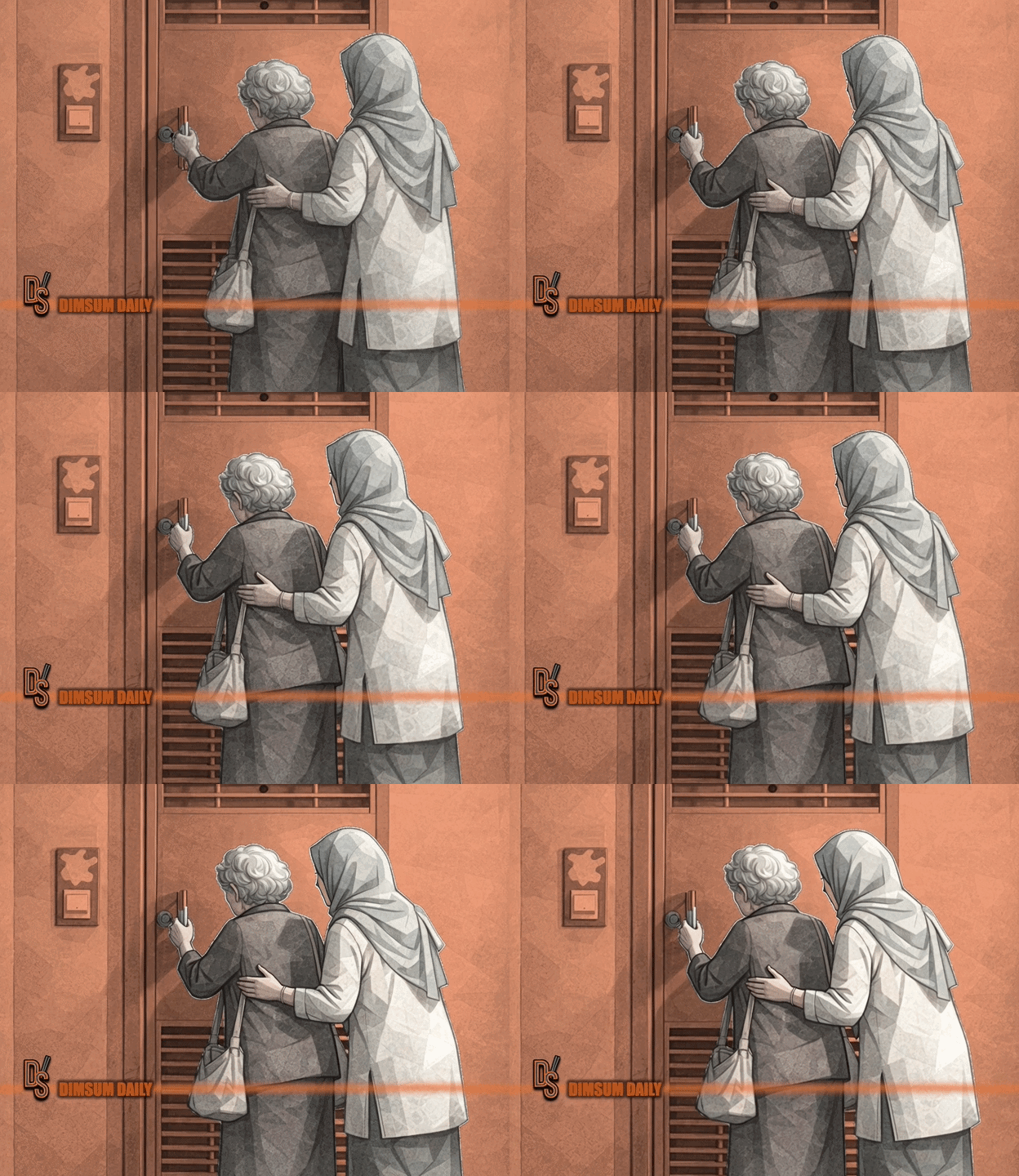
13th October 2026 – (Hong Kong) Before we look at the violence, we should look at the flat. It is about 150 square feet, with a kitchen and a toilet but no separate room. Once a sofa and a bunk bed were put inside, there was barely space for one person to move. For more than three years two people lived there. One was a 93-year-old widow who could no longer speak clearly or use a telephone. The other was the 52-year-old Indonesian domestic helper hired to care for her around the clock. Police say a camera in the flat recorded the helper hitting Madam Kwan about 20 times on the head, neck and face, and stepping on her abdomen, between 8.03am and 8.10am on 11th October. She was declared dead at 9.12am. The helper has been arrested on suspicion of murder, and the courts will decide whether she is guilty. The rest of us face a different question. How did a life become so small that nobody outside it could see what was happening?
The details are quiet, but they add up. Madam Kwan lost her husband 30 years ago and had no children. Her closest relative was a niece, and relatives visited about once a month. The Social Welfare Department was not following her case. It had only helped her apply for financial assistance. When she moved into the estate about seven years ago, she was alert and could get around easily. Then a stroke came on top of colorectal cancer diagnosed years earlier. She soon lost the ability to walk, to speak clearly and to reach anyone beyond her door. This was not one misfortune. It was a slow narrowing of her world, and poverty and loneliness did it together.
Hong Kong already has research that makes this pattern hard to ignore. A study followed 1,696 older people over two years. Those who could not afford basic needs in housing, food, medical care and social life were more likely to say they felt lonely two years later. This held true even after the researchers accounted for health, sleep, marital status and how lonely people felt at the start. Another survey, led by Professor Eliza Wong Lai-yi of the Chinese University of Hong Kong, found that 50.4 per cent of people aged 65 and above were socially isolated. The global estimate is 25 to 33.6 per cent. Research has linked a lack of social contact to a risk of early death similar to smoking up to 15 cigarettes a day.
How this happens is no mystery. Being poor makes it harder to have company. A meal with friends costs money. So does a bus ride to visit someone, or a taxi to a community centre when your knees fail. A tiny flat leaves no room for guests. Pride makes people hide their hardship from neighbours. Loneliness then makes poverty worse. An isolated older person has nobody to explain an allowance, check a bill or notice that the fridge is empty. Each problem deepens the other until the person drops out of sight.
For families of modest means, the answer to frailty is often the only one they can afford. Subsidised care homes have waits of more than a year. Private homes can cost tens of thousands of dollars a month. A helper costs a few thousand. So one worker with no nursing training ends up as nurse, companion and the only link to the outside world. She works six and a half days a week in a single room with no wall between bed and kitchen. Police have not ruled out friction over care, overwork and a long strained relationship. None of that excuses violence. It does show that when an elderly person’s world shrinks to one room, the carer’s world shrinks with it.
The same study offers a hopeful finding. What the researchers call neighbourhood collective efficacy, the sense that neighbours trust each other and will step in, weakened the link between poverty and loneliness. Simply having more names in a person’s network did not. What mattered was whether the people nearby actually acted. When Madam Kwan stopped responding, the helper went downstairs to a security guard. The estate already had people at the door. None of them had any role in checking on her before that morning.
Several steps follow from this. First, Hong Kong measures poverty by income alone. The researchers suggest adding a measure of material deprivation, which would find older people who receive allowances but still go without basic needs. Second, the government plans a shared welfare data platform that will use AI to spot high-risk households. It should flag older people who live alone or only with a helper, have no children nearby, cannot use a phone and have been told they need 24-hour care. Each of these households should get a named social worker and regular visits. Third, public housing estates should treat ties between neighbours as basic infrastructure. Security staff, estate managers and volunteers could make simple check-in rounds and know which flats house a frail resident. Fourth, low-cost group activities should reach housebound older people and include their helpers, who also need rest and someone to talk to.
The government’s Report on Ageing Society Strategies sets out 73 measures, including about 3,500 more subsidised long-term care places by the end of 2027. These are needed, but they count beds and vouchers. They do not count how many people an older person talks to in a week. By 2046, Hong Kong will have 2.74 million people aged 65 or above, and many will be poor, widowed and without children nearby. If the city pays only for care and not for human contact, more lives will shrink to 150 square feet, watched only by a camera that nobody checks.