


























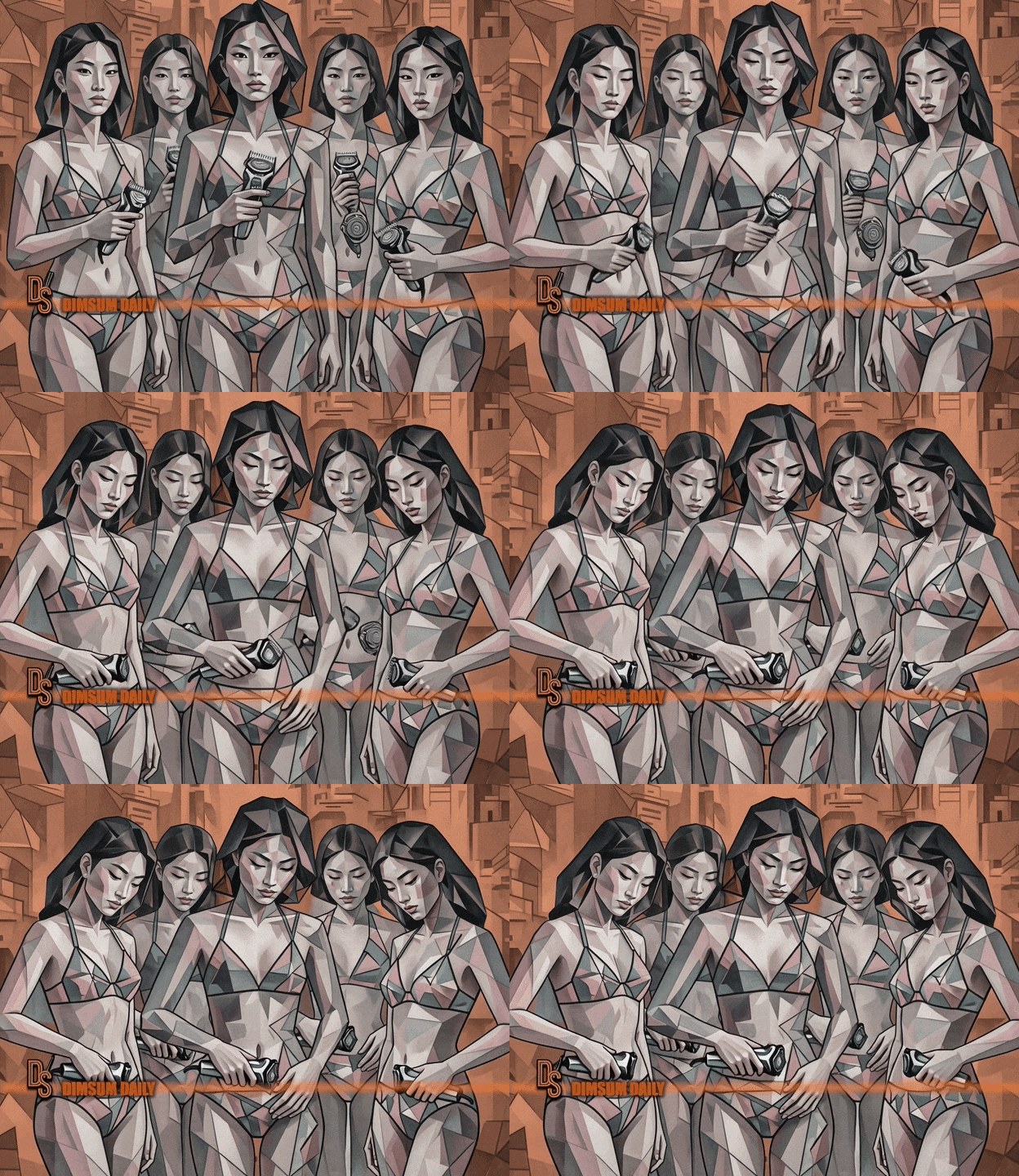
30th September 2026 – (Hong Kong) Watch any debate about women’s body hair for long enough and a pattern appears. The hair itself barely changes. What changes is the story told about it. History shows this clearly. Ancient Romans plucked out their pubic hair one strand at a time with bronze tweezers. In 15th-century Europe a full bush was seen as a sign of health, and a bare one raised suspicion that disease was being hidden. Sex workers and aristocratic women alike wore merkins, or pubic wigs, to fake the hair that lice and infection had taken from them. In the 18th and 19th centuries, lovers gave each other locks of pubic hair as keepsakes. The same patch of skin has been a disgrace, a status symbol, a medical alibi and a love token. A standard that flips that often was never about nature. It was about who got to decide.
For most of Western art history, men decided. Female nudes stayed smooth from the Venus of Willendorf to the late 19th century, carved and painted to represent innocence and chastity. Michelangelo’s David, meanwhile, got a neatly curled crown of hair. When Gustave Courbet painted a full bush in 1866, L’Origine du monde caused such outrage that it wasn’t shown in Paris until 1995. More than a century after it was made, social media platforms were still censoring it. Pubic hair only appeared as something other than a provocation when women such as Suzanne Valadon, Frida Kahlo and Tracey Emin painted their own bodies.
Then came commerce. In 1915, Gillette launched its first razor for women and called body hair “an embarrassing personal problem.” The method is worth noticing. An industry named a flaw and then sold the cure. Low-rise jeans, the Brazilian wax and commercial laser removal later carried that logic into the most private place of all. By the 2000s the bush showed up on screen mainly as a joke, played for laughs and disgust.
Yet the taboo was always thinner than it looked. Pubic hair has a purpose. Doctors note that it helps keep dust, dirt and germs away from sensitive skin, while removing it can cause cuts, ingrown hairs and irritation. None of this means every woman must keep it. It means the case for making hairlessness compulsory never rested on health. It rested on custom, marketing and an old instinct to treat women’s bodies as public property.
The mood is shifting again. Maison Margiela’s Spring 2024 couture show put visible pubic hair on the runway. TikTok users argued over the “full bush in a bikini.” Skims released underwear with fake pubic hair, and it sold out almost at once. A training manager at European Wax Center told The Guardian that clients were moving towards a more natural look. It’s a strange moment when a culture that prized hairlessness starts buying hair back as a novelty. Still, it shows the disapproving stare is losing its power.
Some of the most revealing signs are coming from China. On RedNote and Weibo, young women are dyeing their armpit hair blue, blonde and dragon-fruit pink, and posting tutorials, results and warnings about skin irritation. One young woman, known by the pseudonym Xiaokui, had removed her underarm hair for years after a primary-school friend’s remark left her ashamed. When she dyed it and shared the result online, her friends praised her and her confidence grew. Scholars point out an irony here. China’s “armpit-hair shame” is fairly new. Song dynasty paintings often showed women with visible underarms, and Confucian thought held that the body is received from one’s parents and shouldn’t be altered casually. Actress Tang Wei reportedly let her armpit hair grow for eight months to play a woman in 1930s Shanghai in Ang Lee’s Lust, Caution. The stigma arrived largely with Western films, magazines and razor advertising in the 1980s and 1990s.
So it’s fair to ask what comes next. If armpit hair can go from something to hide to something to colour, the bush may follow. Dye kits made for pubic hair already exist in niche markets, and trends rarely stay in one place for long. Anyone tempted should be careful, because the skin there is more sensitive and dermatologists advise a patch test first. But the bigger point isn’t whether the bush turns pink. It’s that a part of the body once hidden in shame is becoming a place for self-expression.
Hair artist Yumiko Hikage offers a useful warning. “Visibility doesn’t automatically mean freedom,” she says, and even “natural” body hair can become another beauty ideal. The aim isn’t to swap the Brazilian for a compulsory bush or a rainbow one. That would just be a new rule dressed up as liberation.
What needs to change is the default assumption. A woman’s pubic hair shouldn’t be subject to a partner’s veto, a peer’s judgement or a stranger’s joke. It should be treated like the hair on her head, hers to cut, keep, shape or colour. Societies change slowly, but they do change. The painting once too scandalous to show now hangs in the Musée d’Orsay.
As one Chinese commentator put it, this was never about shame but about choice. Some women will remove it, some will keep it and some will dye it. After centuries of other people deciding, the woman who grows it should have the final word.