
























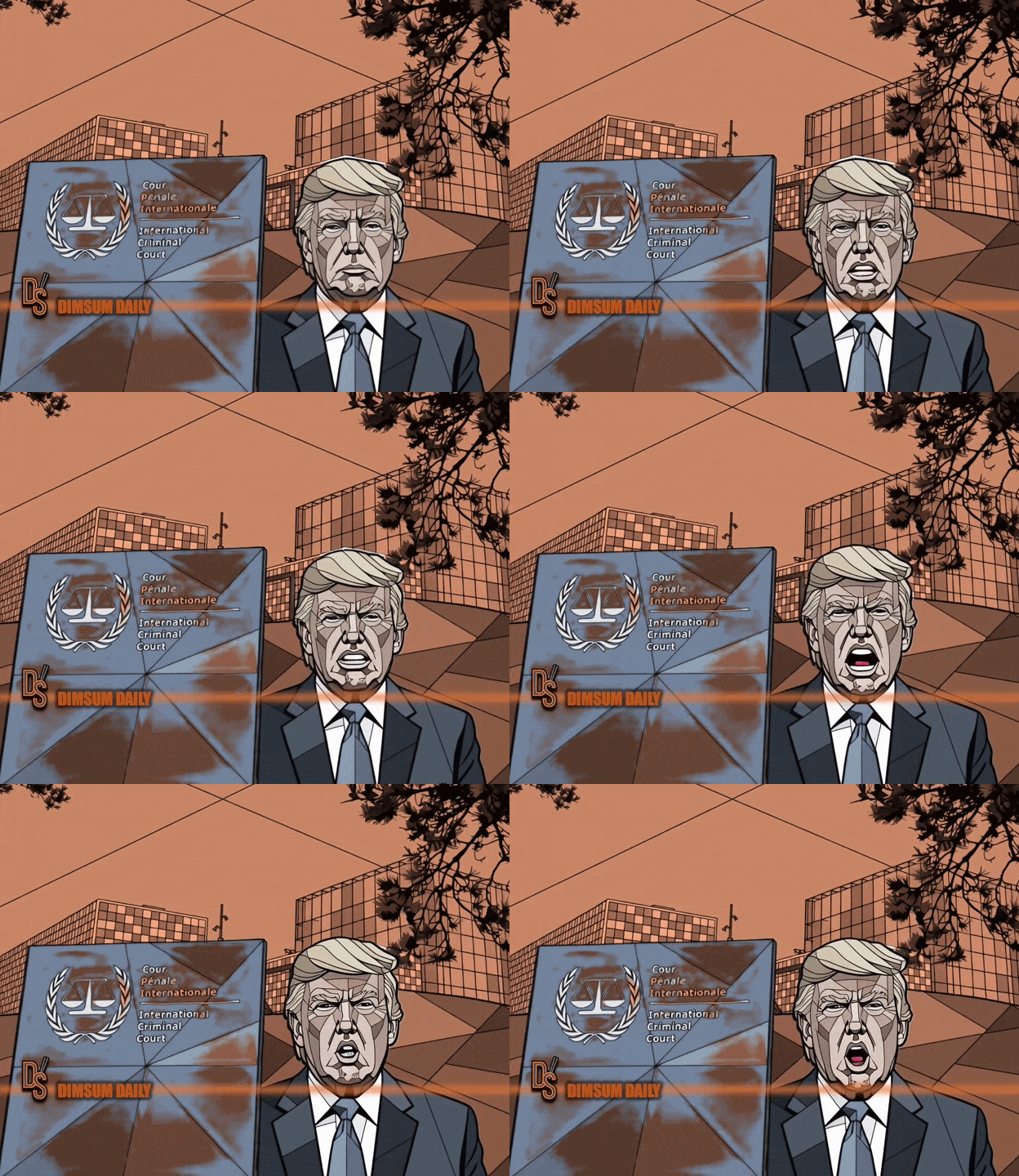
24th August 2026 – (Washington) When Secretary of State Marco Rubio announced sanctions on 18th August against International Criminal Court President Tomoko Akane of Japan and senior trial lawyer Abdoulaye Seye of Senegal, he framed the move as self-defence. The court, he said, was “corrupt and fatally politicised,” a threat to Border Patrol agents and Marines who might otherwise be “left at the mercy of foreign judges thousands of miles away.” Beneath the spin, the announcement revealed more than it meant to i.e. half of the ICC’s eighteen judges are now under US sanctions, with American assets frozen, access to the dollar system cut off, and Apple and Amazon accounts terminated overnight.
The stated justification does not survive close inspection. The United States is not a party to the Rome Statute, so crimes committed on American soil fall outside the court’s reach. No case against a US citizen is currently pending. Immigration enforcement happens on domestic territory the ICC cannot touch. The one plausible exception—the targeted killing of at least 177 alleged drug smugglers in the Caribbean since last summer, described by former ICC prosecutor Luis Moreno Ocampo as potential crimes against humanity—is precisely the kind of exposure Washington now seems determined to foreclose before it materialises. The pattern suggests the campaign is pre-emptive, clearing obstacles rather than answering charges.
Andreas Schüller of the European Centre for Constitutional and Human Rights notes that Washington had been applying diplomatic pressure on other governments for more than a year before making it public. Declaring it a formal “campaign” signals something colder and more deliberate: a strategy to pull in states, including non-members, to raise the cost of supporting the court. The instrument is not a court order or a treaty but the reach of the dollar. Cut off from SWIFT, frozen out of American banks, an ICC judge becomes untouchable to any globally active financial institution. Overcompliance does the rest, as companies far from Washington quietly decide the institution is not worth the risk.
The ICC was built on the legacy of Nuremberg and the tribunals for the former Yugoslavia and Rwanda, and its jurisdiction is confined to aggression, genocide, war crimes, and crimes against humanity. That design was never neutral. Its early docket was almost entirely African—Uganda, Congo, the Central African Republic, Sudan, Kenya, Libya—and even with the later warrants for Vladimir Putin, Benjamin Netanyahu, Rodrigo Duterte, and the Taliban, its convictions remain concentrated there. The preliminary examination of Iraq, involving a US ally, was closed. The Afghanistan inquiry narrowed to Taliban persecution of women and girls. The framework has little to say about economic coercion, resource extraction, environmental ruin, or the humanitarian collapse that unilateral sanctions can inflict on entire populations. Whether starving a nation through financial blockade constitutes a crime is a question the court was structured never to ask.
The procedural architecture reinforces the imbalance. Articles 13 and 16 of the Rome Statute hand the UN Security Council powers of referral and deferral, giving its permanent members indirect influence over the court’s agenda. Article 98 lets states shield their nationals through bilateral agreements—an escape hatch Washington has used to full effect despite never joining the treaty. The court that America now portrays as a rogue tribunal was, in practice, one it could already largely steer.
The escalation is therefore best understood against a shifting backdrop rather than any immediate legal threat. The failed New International Economic Order movement of the 1970s tried and failed to rebalance a Western-centric system. What is different now is the underlying material shift: the rise of China and other emerging economies, the reordering of supply chains, the slow erosion of dollar dominance through de-dollarisation and local-currency settlement. As the Global South gains economic autonomy, the era in which one power could dictate the enforcement of international law grows less secure. A pro-Western institution suddenly treated as an intolerable nuisance is a symptom of that anxiety, not its cause.
The response will be decided less in The Hague than in the capitals of member states, and Japan is the clearest test. Tokyo is the court’s largest single funder, supplying roughly fifteen per cent of its budget, and Akane is a Japanese national put forward by her own government. Prime Minister Sanae Takaichi, who has invested heavily in her relationship with Trump, called the sanctions merely “very regrettable” and stopped short of demanding their withdrawal—a striking retreat from a government that months earlier called the ICC a “foundation for peace.” The Netherlands, by contrast, invited Akane for talks and reaffirmed its backing. That gap between hosting a court and defending it under pressure is the real measure of whether the postwar order still commands loyalty, or merely nostalgia. If Washington’s largest financial partners in the system decline to protect it, the campaign will not need to win any legal argument to succeed.