




























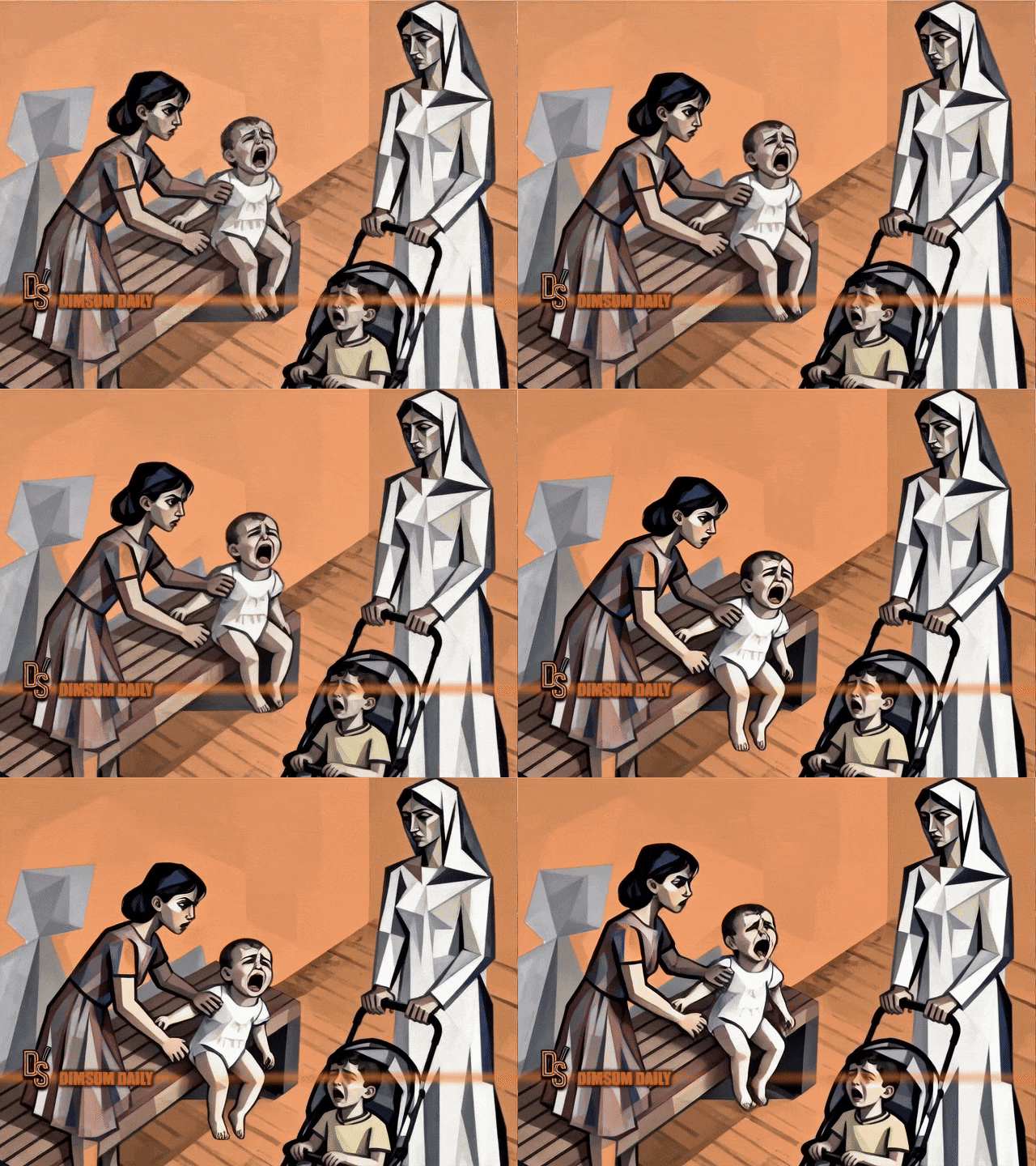
2nd October 2025 – (Hong Kong) The recent arrest of a 37-year-old Pakistani mother in Hong Kong following the circulation of a disturbing video of her eight-year-old daughter mistreating an infant has cast a spotlight on the indispensable role of parents in influencing children’s behaviour. The images of an 11-month-old baby girl being pushed off a bench, falling face first as her cries echoed across social media, have triggered outrage and deep discomfort. The arrest was made not because the eight-year-old could bear legal culpability, but because of alleged neglect by the adult responsible for her. This is not a story about one reckless act in a transitional housing estate in Hung Hom; it is a story about the slow erosion of parental accountability and the long shadow it casts over childhood development.
The video that caused such distress is more than evidence of a child’s impulsive act—it is a mirror reflecting how values and boundaries are communicated within families. In the digital age, an incident does not simply remain in the confines of one housing block; it ricochets across the internet, dissected by millions whose collective outrage is both cathartic and damning. The child in the video will not be charged under the law, but the questions raised about her upbringing strike at the foundations of parental duty. One does not arrive at such behaviour in a vacuum, and the issue is more complex than an isolated shove delivering bruises to an infant.
Parental involvement is not a courtesy to one’s children—it is the essential scaffolding upon which behaviour is formed. A child learns not only through instruction but through daily observation, absorbing cues about how to respond to conflict, frustration, or vulnerability. A mother or father who demonstrates empathy, patience, and respect offers their child a framework for imitation. Conversely, an inconsistent, inattentive, or overwhelmed parent leaves their child without clear templates, amplifying confusion and heightening the risk of impulsive or harmful responses towards others. In the Hung Hom case, the eight-year-old’s behaviour is not simply a childish prank gone awry; it may be a reflection of the absence of active parental modelling.
The consequences of neglect extend far beyond a single moment of misjudgement. Studies across child psychology repeatedly conclude that consistent parental engagement is directly tied to healthier socialisation, better emotional regulation, and enhanced academic outcomes. Where parents fail to be present—whether physically due to work pressures, emotionally due to stress, or psychologically due to detachment—children are left to improvise. Such improvisation is perilous, as they cobble together behavioural norms from peers, fragmented interactions, or even the chaotic churn of online content. In these environments, empathy can wither and reckless behaviour can thrive, unchecked until tragedy or scandal arrives.
Hong Kong is no stranger to cases of child neglect spiralling into lifetimes of damage. From the highly publicised Tuen Mun abuse that ended in the death of a five-year-old girl in 2018, to escalating figures reported by the Social Welfare Department showing a disturbing 50 percent rise in child abuse allegations between 2020 and 2023, the pattern is impossible to ignore. Each high-profile tragedy prompts more rules, such as the forthcoming mandatory reporting ordinance, but legalistic solutions cannot substitute the daily acts of parental presence: the listening ear, the corrected tone, the setting of clear limits.
The tendency to criminalise only the moment of harm risks neglecting the root cause. Children are not born cruel; they learn behaviour by absorbing the emotional signals around them. An eight-year-old girl who mishandles an infant is herself still a pupil learning what care, restraint and responsibility mean. She has no capacity to untangle consequence from impulse without adult intervention. If her mother was indifferent, distracted, or struggling under the pressures of life in transitional housing, then the lesson that boundaries matter was never consistently taught. Ignorance of that reality does not reduce culpability; the law rightfully demands that a guardian bear responsibility for what their child does under their care.
The uncomfortable truth in this story is that strong parental involvement requires more than simply avoiding abuse; it demands active, continuous participation in shaping the child’s moral compass. It requires communication that develops self-regulation, conversations that stimulate empathy, and routines that establish stability. A parent sets the invisible guardrails of conduct, not only by enforcing punishments when behaviour slips but by daily reinforcement of what is right. In homes where adults fail to model self-control, it is little surprise when children lash out in ways that shock the public.
Societies too often push responsibility onto schools. Teachers are expected to mould not only academic proficiency but also compassion, resilience, and respect. Yet research consistently demonstrates that classroom efforts falter when not mirrored at home. Parents remain the first and most enduring teachers. Where schools can expose children to knowledge and social interaction, parents transmit something deeper: the lived experience of how to treat others. A school cannot regulate what a child does with a sibling after class. Only parents can.
The arrest at Good Mansion raises deeper questions about community and collective responsibility. It was neighbours who recorded the painful scene and later alerted police. Some asked why the bystanders did not intervene rather than film. Yet the deeper issue is why a child was placed in a position where such intervention was needed at all. Neighbours are not guardians. Community vigilance is important, but it is no substitute for parental duty. When gaps widen, it is the smallest and weakest—babies and young children—who suffer most.
The outrage on social media reflects an instinctive societal defence of children, but the volatility of that outrage should not obscure the underlying systemic failure: parents absent, overwhelmed, or choosing detachment from their duty. The incident in Hung Hom is uniquely distressing because it was public, filmed, shared, and dissected. Yet it is only one manifestation of a far larger pattern of inadequacy. For every viral video lies countless unseen moments in kitchens and living rooms where neglect breeds and empathy withers.
To prevent repetition, governments can legislate, schools can teach, and neighbours can report. However, the unmovable core is parental involvement. No government ordinance can convince a child she has value as effectively as a mother who listens attentively, a father who plays consistently, or parents who model restraint amid stress. Conversely, no law can disappear the void created when parents abdicate this role. Children do not remember compliance paperwork; they remember tone, touch, presence, and example.
The tragedy of this latest case in Hong Kong is not only the bruises sustained by an infant but the revelation that a young girl already lacked the guidance required to understand why her actions were harmful. This is why parental involvement is irreplaceable. A secure, engaged, and attentive parent does not guarantee perfect outcomes, but absence all but guarantees vulnerability, recklessness, and risk.
The role of parents, and particularly of mothers who often carry disproportionate responsibility for daily caregiving, is nothing short of foundational. Through their example, children either learn kindness or indifference, patience or aggression, empathy or detachment.