

























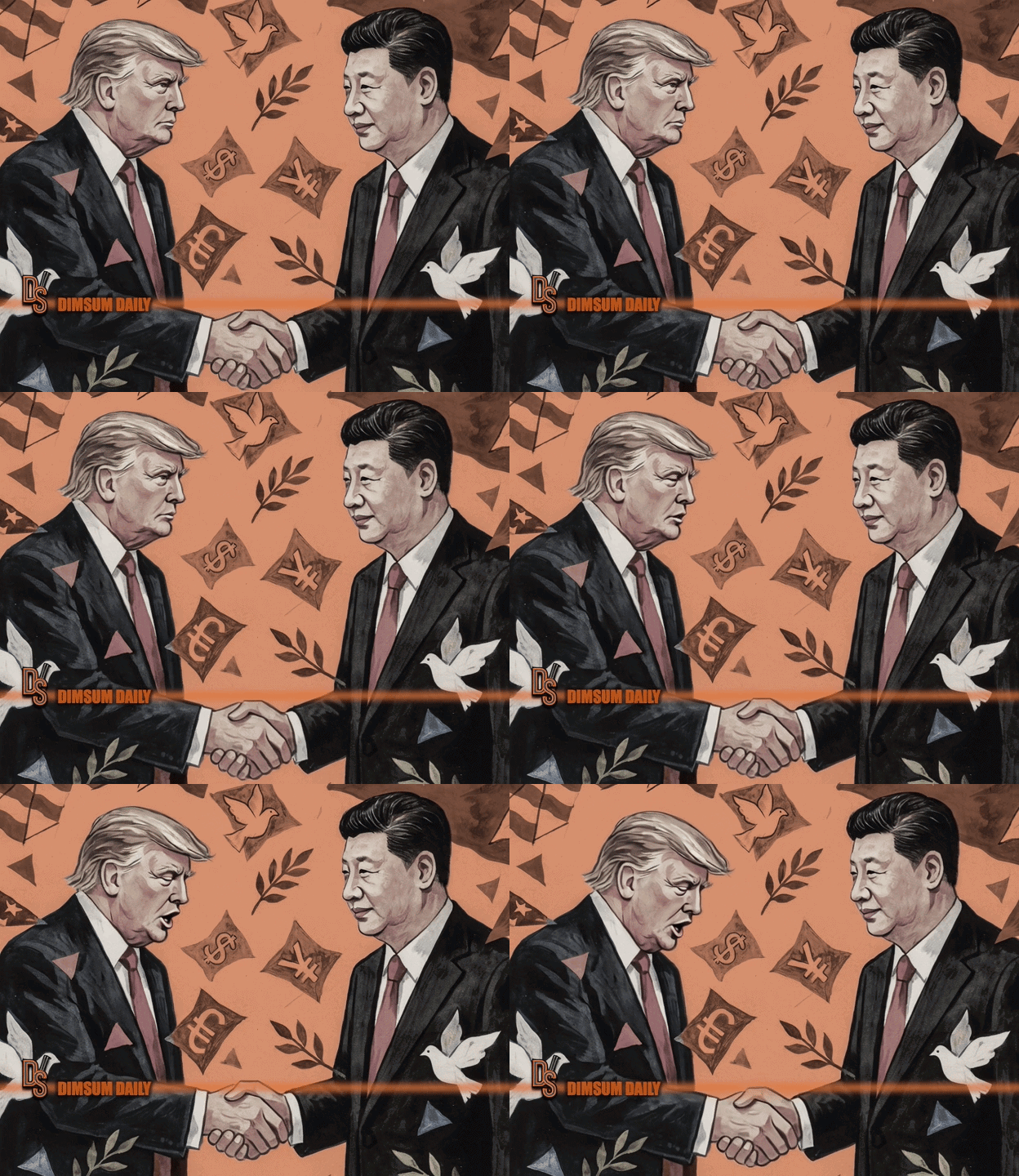
28th September 2026 – (Beijing) Most people judge a summit by its final photographs. A better test is what happens in the weeks after the cameras leave. On 26th September, President Xi Jinping and President Donald Trump both called their Washington talks “very successful.” That was expected. What came next was less expected and told us more.
Within days, Beijing announced an eight-point consensus. China’s Ministry of Commerce set out a reciprocal tariff cut covering about US$30 billion of goods on each side. New councils, working groups and dialogue channels were named and given mandates, and several were given deadlines. Read closely, these documents describe more than a thaw. They describe a relationship being rebuilt on terms that China proposed and the United States accepted.
The main outcome is a phrase: “a constructive China-US relationship of strategic stability based on respect, fairness and reciprocity.” The first half was agreed when Trump visited Beijing in May. The second half is new, and it matters.
Foreign Minister Wang Yi defined each word. Respect means respecting each other’s sovereignty, territorial integrity, chosen social system and core interests. Fairness means mutually beneficial cooperation, handling differences through consultation and not seeking unilateral absolute advantage. Reciprocity means the two countries are equal in sovereignty, with neither standing above the other and neither engaging in bullying.
It’s worth asking what these definitions are responding to. For much of the past half century, Washington set the terms of the relationship. In the 1970s it held the strategic advantage. In 2001 it backed China’s entry into the World Trade Organization under rules written mostly in the West. In 2017 it labelled China a strategic competitor and started a trade war. As the editorial board of Hong Kong’s HK01 noted, each of the three principles answers a stance Washington once took toward Beijing. The United States has now signed on to language drafted in Beijing. That is a quiet but important change in who sets the agenda.
The two sides will set up a China-US Trade Council, and they have already agreed on its mandate and procedures. An Agriculture Working Group under the council will take up market access and regulatory barriers, and it is due to meet by the end of 2026. A separate China-US Investment Council will give both sides a standing place to discuss opportunities and obstacles. Negotiators also talked about adding direct passenger flights and bringing US coal into the tariff framework ahead of possible purchases in 2027 and 2028.
The most forward-looking step concerns artificial intelligence. Vice-Premier He Lifeng and US Treasury Secretary Scott Bessent will lead a dedicated AI dialogue, with the next session set for the end of November. The two sides will also open a channel for reporting AI-related incidents. For years, Washington treated technology mainly as something to restrict. Treating it as something to manage together is a real change in thinking.
Other outcomes follow the same pattern. They include military communication, a proposed memorandum on crisis prevention, joint work against transnational crime and narcotics, and the search in China for the remains of missing US service members. Each gives officials a practical reason to keep talking.
This is the method. Competition doesn’t disappear, but it gets directed into institutions. A relationship with many points of contact is much harder to break than one that hangs on a single phone call between leaders.
It would be a mistake to read these outcomes as China giving ground. Beijing negotiated from strength. It handled repeated tariff pressure calmly and answered in proportion. Its position rests on real industrial capacity and leading global output in electric vehicles, power batteries and solar equipment. Because the tariff cuts are reciprocal and will take effect at the same time on both sides, they reflect the principle of equality rather than a one-sided favour. Extending the Kuala Lumpur arrangement from November 10, 2026 to January 10, 2027 gives businesses on both sides some welcome predictability.
American companies already understand the stakes. US firms have set up more than 84,000 foreign-invested enterprises in China. In a US-China Business Council survey, 92 per cent of American companies said they were profitable in China in 2025, and 95 per cent called the Chinese market important to their global competitiveness.
The case for cooperation goes beyond trade. China will host the APEC Economic Leaders’ Meeting and the United States will host the G20 Leaders’ Summit later this year, and each has agreed to support the other. Global economic recovery, regional conflicts and the rules for AI, cyberspace and outer space cannot be settled without both countries. The two leaders also recalled that China and the United States were allies in the Second World War. That reminder carries weight for anyone who wants to weaken the postwar order.
The strongest foundation is still people. Xi has announced that 100,000 young Americans will be invited to China for exchanges and study over the next five years. The pandas Ping Ping and Fu Shuang have arrived at Zoo Atlanta. These are small signals of goodwill, but they accumulate over time.
Frameworks only work if they are carried out. It remains to be seen whether Washington will turn its commitments into action on tariffs, technology controls and the Taiwan question. The two countries’ working teams now have to turn principles into practice, one meeting at a time.
Xi has said that China and the United States need not avoid talking about competition, but it should be “a race of catching up with one another, not a wrestle in which one either wins or loses.” The eight outcomes offer a way to run that race. What matters now is whether both sides keep moving forward on it.