

























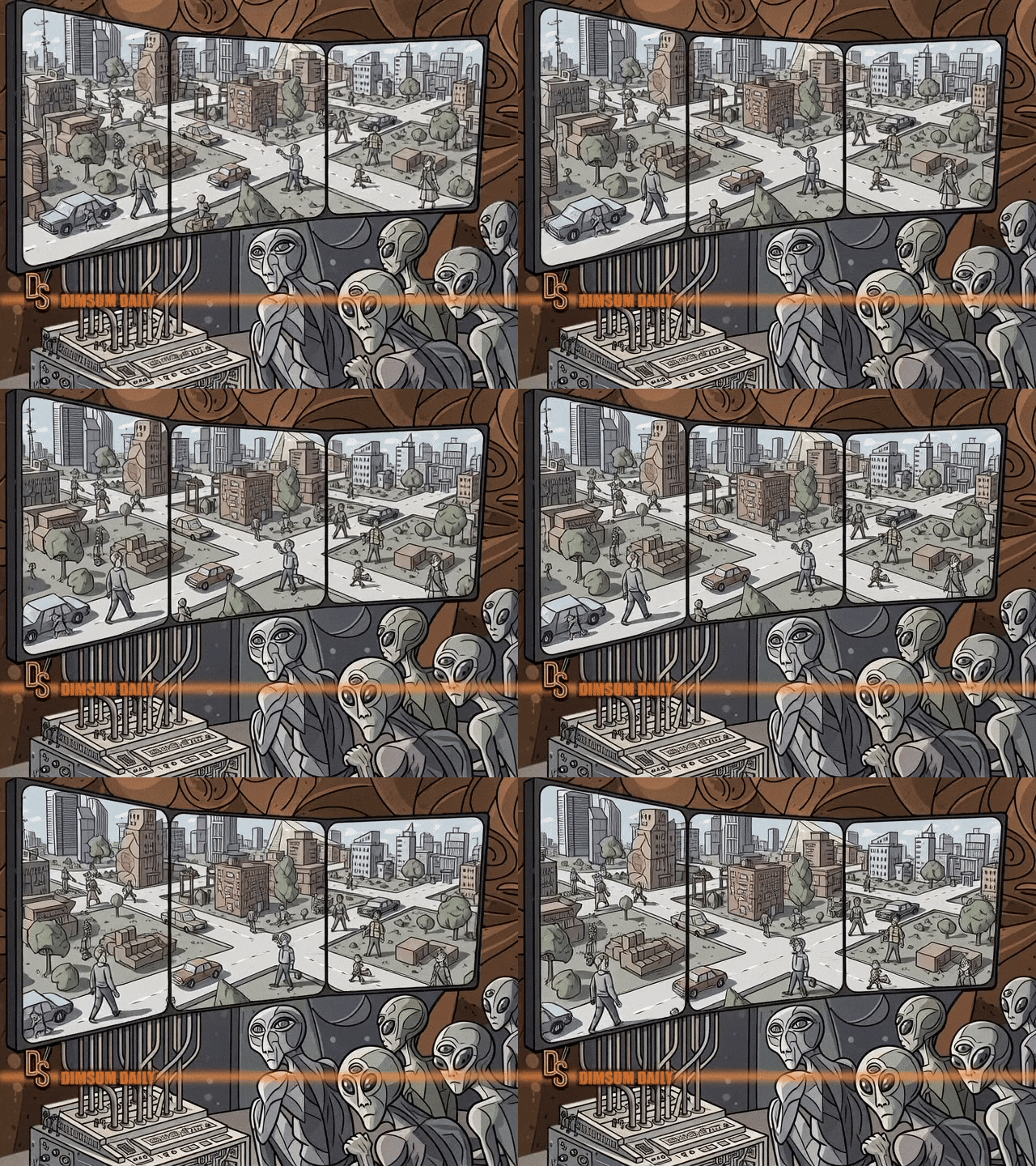
5th October 2025 – (Hong Kong) Can we trust our senses, or has reality always been a kind of programmed dream? For centuries philosophers have wondered whether our experiences are grounded in truth, or merely shadows cast on the cave wall of perception. Now, modern physics and neuroscience are converging on an idea that was once pure science fiction: that our universe behaves like an immense information-processing system, and that what we call gravity could be the operational signature of a vast and invisible computation.
At the University of Portsmouth, physicist Dr Melvin Vopson has revived this dizzying possibility with a new interpretation of gravity—one that moves it from the realm of classical forces into the circuitry of simulated reality. His study, published earlier this year, proposes that gravity may not be a fundamental interaction at all, but a computational necessity arising from how information arranges itself in the universe. As a computer compresses data to save energy, says Dr Vopson, the cosmos might be performing an analogous trick—pulling matter together to minimise informational disorder.
This, he argues, reframes gravity not as attraction, but as information optimisation. Space and time, in this view, are storage media. Every fundamental particle is a unit of data—a binary cell recording either the presence or absence of matter—and the entire universe becomes a seamless rendering, self-correcting to preserve coherence, just as a digital simulation would. The implication is breathtaking: that physical law itself is code, and everything from black holes to brain cells could be computations within a divine algorithm.
The idea of a simulated universe has gained credibility among serious thinkers. Elon Musk, for example, has argued that given the exponential growth of computing power, advanced civilisations would inevitably generate simulations indistinguishable from reality. If such simulations are possible at all, the logic goes, there will be many more simulated worlds than one “real” base universe—so statistically, our chances of living in the simulation are overwhelming.
What differentiates Dr Vopson’s contribution is his attempt to ground this possibility in the physical, measurable world. Building on his previous research suggesting that information possesses mass, he uses the so‑called “second law of infodynamics”—a counterpart to the thermodynamic law that governs energy—to propose that the universe strives constantly to reduce its informational entropy. When pieces of matter cluster under gravity, it is not because of mystical attraction at a distance, but because the computational framework of the cosmos finds it more efficient to store them together as one packet, reducing the energy required to track each individually.
In such a model, gravity is not simply a property of space; it is compression. Computationally speaking, a space with two particles recorded separately as “1” and “1” is more expensive to maintain than a merged entry describing a single combined object. The universe, like a good coder, saves processing power by tidying its data. What we experience as the fall of an apple or the orbit of a planet is merely a side-effect of cosmic housekeeping—a grand system minimising its own informational cost.
Speculative as this sounds, it resonates with the remarkable consistency of physical law. The fact that mathematical equations describe the behaviour of matter with perfect precision has long puzzled scientists. Why does reality obey mathematics so obediently? In a simulated universe, the answer is simple: mathematics is the source code. Every mathematical constant and physical law would be an instruction set embedded in the underlying program, producing the illusion of a continuous, external world.
This possibility dovetails intriguingly with what cognitive science tells us about perception. Neuroscientists such as Dr Daniel Yon describe the brain not as a passive camera recording the world, but as a theorist—constantly predicting, editing, and simulating sensory input to create the illusion of stability. We do not see reality; we see our brain’s best hypothesis about it. Even the colours we perceive are predictions layered on incomplete data. Your retina transmits scattered electrical signals, your brain extrapolates them into an image that feels seamless, and the result is a hallucinatory coherence—a private rendering of a shared simulation.
Every second, the mind performs billions of probabilistic calculations, filling in missing visual and auditory information just as a computer interpolates lost data in a compressed image. The famous optical illusions—the grey square that looks white, the apple that appears red though it is not—reveal this predictive mechanism in action. If our consciousness already builds its own simulated model of experience, the step to a universe-wide simulation becomes less far-fetched. The macro mirrors the micro: the universe processes physical data; the brain processes sensory data. Each is a simulation engine operating at a different scale.
This convergence between cosmology and neuroscience suggests that the boundary between perception and reality may be thinner than we imagine. The universe, under Vopson’s interpretation, calculates information to maintain order. The brain, within that same universe, calculates perception to maintain sanity. Both are optimisation machines seeking consistency. The laws that compress matter under gravity may be the same laws that knit our sensory inputs into consciousness.
The notion that existence could emerge from computation also re‑frames what consciousness itself might be. If matter is information, and information has weight, then awareness could be a by‑product of information processing at sufficient complexity. In that sense, consciousness need not be a mystical property of biology but an emergent feature of code‑based organisation. Artificial intelligence and human intelligence would then be parallel forms of computational awareness—one organic, the other engineered—all within the same simulated framework.
Sceptics will counter that such claims are metaphysical rather than scientific. Yet science has often advanced through the expansion of imagination. Quantum mechanics taught us that particles behave like waves until observed. General relativity overturned our sense of space and time as absolutes. Information physics may constitute the next paradigm shift—showing that the universe behaves exactly as a simulation would, whether or not there is an external programmer.
If this is true, even gravity’s mysteries find an elegant explanation. Dark matter and dark energy, the unseen ingredients supposedly making up most of the universe, could be computational artefacts—corrections made by the system to maintain stability across its grid of data. Black holes, far from being destructive anomalies, might be repositories of maximum compression—the ultimate “zip files” where all informational detail is perfectly condensed.
The idea of pixelated space—quantised cells recording ones and zeros—also aligns with current approaches in quantum gravity. The Planck length, the smallest possible unit of distance, could represent the resolution limit of our universal simulation. Just as increasing magnification on a digital screen eventually reveals the pixels beneath, probing beyond the Planck scale may expose the computational scaffolding of reality itself.
However, perhaps the strangest corroboration comes from our own psychology. The brain’s predictive coding ensures that everything we see passes through layers of expectation, bias and neural editing. Neuroscientists have demonstrated that when we see incomplete scenes, our brains “light up” as if filling in the missing information. Even when no signal is present, our neural activity manufactures a picture. In other words, we hallucinate reality into existence. The mind, a micro‑universe of computation, may simply be mirroring the rules of the greater system it inhabits.
That the illusion works so precisely is, paradoxically, what makes it almost impossible to detect. Just as a non‑player character in a computer game cannot perceive the machine rendering its world, our instruments of perception are confined within the simulation’s architecture. Whenever science appears to approach a boundary—whether probing the quantum foam or the beginning of time—the answers dissolve into paradox, as if the program were concealing its source code.
So what would it mean if Dr Vopson and others are right? Functionally, nothing would change. We would still eat, love, create and die within our world. However, conceptually, everything shifts. The notion that we are living inside a universal computation dissolves the barrier between physics and philosophy. It opens the possibility that existence is an act of continuous calculation—that every thought and event is a line of code executed by a cosmic processor.
This rendering of reality, far from diminishing human significance, could elevate it. If consciousness is a computational phenomenon, then every sentient being becomes a collaborator in the ongoing refinement of the simulation. We are not merely users of reality’s interface; we are co‑processors feeding the system with data—each thought, each discovery, adding another layer of meaning to the code that sustains us.
The evidence remains circumstantial, yet beautifully self‑consistent. Gravity acts as a compressor, keeping the universe efficient. Our brains perform the same optimisation, keeping perception coherent. In both cases, the governing principle is informational economy: a drive toward elegance over chaos. Whether this points to a divine architect or a mathematical inevitability depends on philosophical taste. What science now permits, however, is the sober proposal that the universe operates exactly as a vast simulation would.
Disbelievers may dismiss the argument as another clever metaphor. However, metaphors have often preceded revolutions in thought. Once the Earth was the centre of the cosmos, until mathematics revealed otherwise. Once energy and matter were separate, until relativity united them. Perhaps now it is information’s turn: the final bridge between matter and mind, proving that the cosmic architecture we inhabit is less solid than code—and yet no less real for it. After all, if gravity itself is but the shadow of computation, the most profound illusion may be the one convincing us we are not part of the machine.