























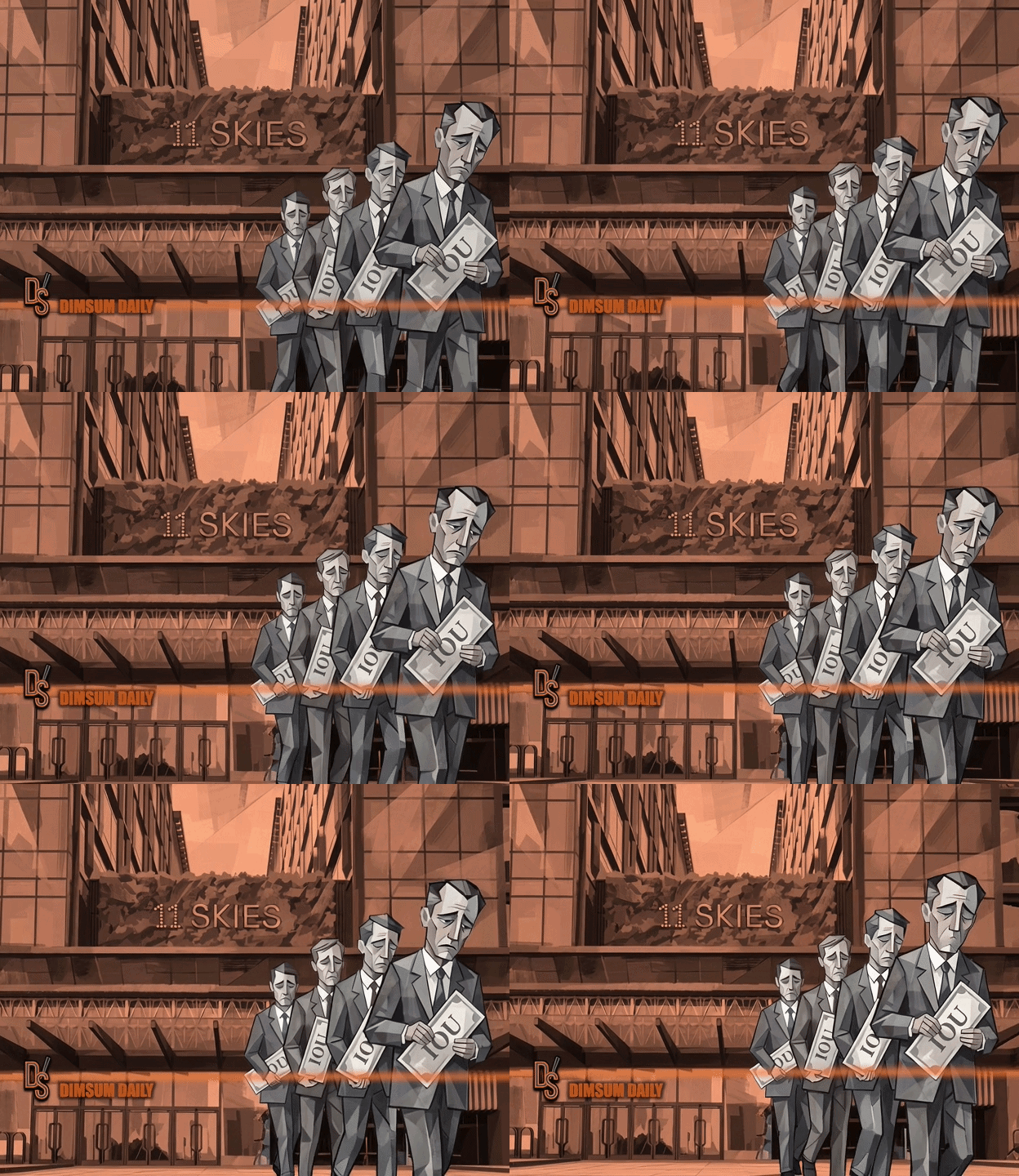
14th October 2026 – (Hong Kong) The quietest place at Hong Kong International Airport may be the one built to be its busiest. Next to Terminal 2, the 11 Skies complex covers 3.8 million square feet of floor space. It was planned around 800 shops, 120 food and drink outlets, entertainment venues and three office towers. Today its corridors are dim and many are boarded up. Only one office tower has tenants. This is where New World Development set out to prove its ambition. It is now where the developer has shown how much patience Hong Kong will extend to a borrower that is too big to fail.
On a Wednesday evening in late September, New World’s results were late and its executives missed a scheduled briefing. Hours later the deal was announced. The Airport Authority would end New World’s contract of nearly 50 years and take full control of the HK$18 billion project. That contract required minimum rent of at least HK$1.8 billion a year. Over the decades still to run, the nominal total would have been tens of billions of dollars. Instead, New World will pay HK$2.3 billion in cash and provide about HK$1.05 billion in works and services. The building passes to the Airport Authority at no cost.
New World reported a net loss of HK$26.8 billion for the year to June, after HK$18.3 billion in impairments and provisions linked to 11 Skies. Total debt was HK$143.3 billion and net debt HK$126.3 billion. Net gearing rose to 68.3 per cent from 58.1 per cent a year earlier. Total debt fell, but the write-offs reduced equity, so the ratio moved the wrong way. Nearly US$11 billion of debt could fall due as early as next year. Dividends and payments on its perpetual securities remain suspended.
Core operating profit rose 28 per cent to HK$7.7 billion. Underlying profit was HK$2.2 billion, compared with a loss of HK$1.2 billion a year earlier. Contracted sales of HK$29.6 billion beat guidance. The business still sells flats and makes money from them. As one Chinese-language columnist put it, a developer’s results describe two companies. One is the valuation company, which can lose billions on paper in an afternoon. The other is the operating company, which keeps working. Because the operating company still works, lenders can tell themselves that patience is prudent.
Last year, while New World was refinancing a record amount of debt, officials from the Hong Kong Monetary Authority contacted lenders directly. A rollover was agreed days before the deadline. This month the group added about HK$1 billion to a loan facility. It also launched an offer for bondholders to swap three US dollar note series, with about US$991 million outstanding and due in January 2027, June 2027 and February 2028. In exchange, a new unit would issue up to US$600 million of 7.375 per cent senior secured notes maturing in 2032. Bonds that were due within two years would be pushed out by about five more. Investors who swap get collateral. Those who stay behind rank lower than they did before. This is not a default. It is a formal request for more time, and the market expects it to be granted.
The Airport Authority has an option to buy 750 million New World shares, about 30 per cent of the company, from Chow Tai Fook Enterprises for HK$2.25 billion within three years. That works out at HK$3 a share, about 43 per cent below the market price. It looks like a strong safeguard for the public body. However, the option comes with a condition that the Cheng family must remain the largest shareholder. A protection for the public is therefore also built to protect the family’s control. Talks with Blackstone over a US$4 billion tie-up reportedly broke down because the family would not give up control. The new deal leaves control untouched and gives the family until late 2029 to rebuild the capital structure. As Brock Silvers of Kaiyuan Capital observed, the family has yet to put significant additional private capital at risk.
Julian Lee Pui-hang of the Airport Authority said that taking New World to court would have cost years and risked a “lose-lose situation.” A finished building stuck in litigation helps no one. The authority now gets the structure, the cash and the freedom to fold it into SKYTOPIA, with a phased opening between late 2028 and 2029. The project’s misfortune was also real. It was planned in 2018 at the peak of airport traffic, then hit by a pandemic and by Hong Kong residents’ shift to spending across the border.
The important question is the precedent. A restaurant owner who falls behind on rent gets a demand letter, not a negotiated exit. A small contractor who misses bond payments faces winding-up proceedings, not a call from the regulator to its lenders. Gary Ng of Natixis said the deal highlights New World’s importance to economic policy, especially as the Northern Metropolis depends on developers taking part. That is exactly the problem. Once a borrower is needed to deliver policy, its debts are no longer just its own. Some of the risk moves to the public, while the upside and the control stay in private hands.
Being too big to fail does not mean a company never fails. It means that when it fails, the cost is spread widely and quietly. The answer is not to let New World collapse, which would hurt homebuyers, workers and banks. The answer is to make the price of rescue clear. Further support should be tied to timelines for new equity, published targets for cutting debt and a real willingness from the family to put its own money at risk.